
Engineering and complex delivery
Apply the ideas in construction, infrastructure, engineering, manufacturing, energy or sustainability projects. Examples can explore interfaces, physical progress, commercial commitments and delivery uncertainty.
Turn planning, cost, risk and performance information into confident project decisions. Build an employer-agreed pathway, apply it in your role and develop evidence of your professional contribution.

Results supplied by KBC. Figures describe reported achievement, not a guarantee of an individual result; the general pass rate is not an apprenticeship achievement-rate measure. Ask KBC for the relevant cohort and reporting period.
Project controls brings together the information needed to understand where a project stands, what may happen next and which action could improve delivery. This Level 6 apprenticeship develops occupational knowledge, skills and behaviours through structured teaching and new learning in an appropriate employed role.
You will connect planning and scheduling with cost, risk, change, governance and communication. Your coach helps you explain the reasoning behind your work, evaluate its quality and show how your contribution supports your organisation.
The programme can suit planners, schedulers, cost and project-controls practitioners, reporting analysts, risk and assurance specialists, PMO professionals, engineers and project leaders developing broader controls responsibilities. You need an employed role with opportunities to learn and demonstrate the complete occupational standard.
Before confirming a place, KBC reviews your responsibilities, previous learning and development needs with you and your employer. A senior title alone does not establish suitability, and previous experience does not automatically exclude you. The review identifies the substantial new learning the apprenticeship will provide.
Apply the ideas in construction, infrastructure, engineering, manufacturing, energy or sustainability projects. Examples can explore interfaces, physical progress, commercial commitments and delivery uncertainty.
Use project controls in consultancy, finance, marketing, digital or wider business transformation. Explore investment priorities, change delivery, stakeholder decisions and measurable organisational outcomes.
Examples and templates can reflect your sector. The Level 6 standard and assessment requirements remain the same; KBC and your employer must agree suitable duties, learning opportunities and evidence access.
KBC uses learning credits to organise this pathway. A normal module is one credit over four months. PMP preparation takes two credits across eight months; Certified PMO Professional takes four credits across sixteen months. These are KBC pathway units, not a promise of transferable university credit.
Select a mix totalling six credits with KBC and your employer. The menus below show options, so every item in a menu is not automatically included. Your written offer names the selected modules, professional examinations and memberships. Timetabling, eligibility and your occupational learning needs determine the final sequence.
Build the practical disciplines behind a reliable schedule, baseline, forecast and controls conversation. Choose a balanced set from this operational menu.
Develop the wider view needed for programme, portfolio and PMO decisions. Discuss which balance of controls, governance and strategic practice fits your responsibilities.
The four Certified PMO Professional modules cover PMO and organisational governance; planning and integrated controls; risk, issues and quality; and stakeholder engagement, communication and reporting. Add AI and an agreed earned-value or portfolio option to complete the six-credit mix.
Certified PMO Professional is a separate KBC learning route from PMI PMO Certified Professional. APM’s recognition of the KBC assessment supports the technical-knowledge element of Chartered Project Professional Pathway 2; completing it does not itself confer ChPP.
Check APM’s recognised assessment listing ↗Discuss changes to the mix with your employer and KBC. Prior learning, your job responsibilities and the opportunities to develop evidence guide the decision. A different module or learning level is considered only where it supports the agreed plan and all occupational requirements remain covered.
Additional Level 7 study is optional professional development. It is separate from the Level 6 apprenticeship and must not be used to replace its required training or counted as funded off-the-job learning merely because it appears in the wider offer.
Each module connects subject knowledge with practical work. Prepare with guided materials, discuss ideas in class, try suitable techniques and evaluate what happened. Your monthly submissions combine completed learning-platform activities with evidence of application and reflection.
The examples opposite illustrate possible outputs. They are not a requirement to produce every document. Your coach and employer agree what is relevant, achievable and appropriate for the applicable assessment plan.
Show your own contribution and use authorised, anonymised or redacted evidence. Protect employer, client, colleague and commercially sensitive information. Learning reflections support development; they are kept separate from an EPA portfolio where reflective accounts and self-assessment are excluded.
September, January or May: discuss your role, prior learning and support needs; complete checks; arrange platform access and your employer-supported plan.
Each semester begins on the first Friday of October, February or June. First-semester induction takes place in the first week. Each semester has 14 two-hour classes and one reading week.
Consolidate learning, review suitable evidence and prepare for the professional discussion and other assessment requirements. Readiness is reviewed with your employer.
Complete the independent assessment under your applicable assessment plan. The current plan describes a typical six-month EPA; your assessment organisation confirms the schedule.
KBC’s planned structure is one soft-start month plus 26 months of learning, followed by EPA. This preserves the original 27-month pre-assessment outline: one soft-start month, 24 teaching months and two closing months.
The current national standard lists a typical 48-month duration excluding assessment and a minimum of 835 off-the-job training hours. KBC’s shorter delivery plan is not the national typical duration. The final duration and hours must be individually agreed after initial assessment, with enough protected time to meet the full requirements. A shorter timetable does not itself reduce the required learning; eligible, evidenced prior learning is assessed separately.
| When | Planned time | What you will do |
|---|---|---|
| Every teaching week | 2 hours | Interactive online class with your tutor; recordings support agreed catch-up and flexible learning. |
| Every week | 2–3 hours | Guided reading, videos, podcasts, quizzes and preparation using the learning materials. |
| Every month | 7 hours | Your monthly assignment: apply learning to work, explain decisions and show relevant evidence. |
| Every month | 1 hour | Present your progress to your coach, review evidence, discuss support and agree next steps. This is the monthly coaching meeting. |
| Every 10 weeks | 1 hour | Your coach presents progress to your manager, with you participating. Review workplace impact and agree priorities together. |
This is KBC’s regular study rhythm. Your individual training plan also allocates any additional occupational training and workshops needed to meet your programme’s requirements. Learning workload and eligible off-the-job training hours are different measures; progress reviews, administration and examinations do not automatically count as training.
Present your progress in knowledge, skills and behaviours, discuss your work and identify the next learning priority. The one-hour coaching meeting includes your progress presentation; it is one meeting, not an extra hour.
Submit monthly work and learning records through Aptem by the 20th, or the next working day. Your coach reviews learning activities, relevant workplace evidence and the support you need.
Your coach presents progress to your line manager, with you participating. Use the one-hour review to discuss workplace feedback, impact, learning time, evidence opportunities and the actions that will help you move forward.
Arrange meetings ahead of time and let KBC know promptly if your role, manager, employment or circumstances change.
Your employer must agree suitable duties, support the pathway and protect the paid learning time in the training plan. Managers help provide opportunities to practise new skills, access appropriate evidence and participate in reviews. Apprenticeship learning is part of your employed development, not simply an evening course added to a full working week.
Eligible off-the-job training develops new occupational knowledge, skills or behaviours and takes place within paid working arrangements under the applicable funding rules. Your plan allocates all necessary training beyond the regular class and assignment rhythm. Routine productive work, administrative record keeping, progress reviews, examinations and assembling a portfolio do not automatically count as off-the-job training.
You record the actual qualifying activity, time and learning. Where exceptional training outside normal hours is agreed, the applicable payment or time-off arrangements must be in place. KBC checks the programme-specific minimum and your individual plan; there is no blanket 20% or six-hour rule applied to every new learner.
Classes, questions, assignments, feedback and workplace application develop your knowledge, skills and behaviours. Monthly coaching helps you recognise gaps and improve your evidence before the closing stage.
At gateway, KBC and your employer review readiness against the applicable assessment plan, including required evidence, English and maths where applicable, and any mandatory qualifications. Completing the six credits alone does not automatically establish gateway readiness.
The current Project Controls Professional assessment plan contains a technical work-based assignment with a report, presentation and questioning, and a professional discussion supported by a portfolio.
The assessment organisation controls formal arrangements and independent grading. Your coach explains the applicable version, permitted evidence, deadlines, adjustment requests and preparation. Professional-body examinations are separate from these apprenticeship assessment methods.
Keep your developmental reflections separate from the formal EPA evidence portfolio. The current plan excludes reflective accounts and self-assessment from that portfolio. The technical assignment is completed under the assessment organisation’s instructions after gateway; do not assume a teaching assignment can simply be submitted in its place.
The national standard and its linked assessment document contain different typical on-programme duration statements. KBC uses the current standard for the headline duration and minimum hours, the applicable funding rules for training requirements, and the relevant assessment plan for assessment methods. Your written training and assessment arrangements identify what applies to your start.
Complete all required revision questions, quizzes and final revision activities. Keep your off-the-job learning record current and review readiness with your coach.
KBC or IPC pays for the non-apprenticeship professional examinations included in your agreed offer when the revision and learning-record conditions are met. The team confirms eligibility, the funded attempt and the booking.
The professional examination for your final module is taken after completion of the EPA requirements, so you can focus on apprenticeship assessment first. Your coach helps coordinate dates and preparation.
A professional-body examination is separate from apprenticeship assessment. Any qualification that is mandatory for gateway must follow the applicable assessment plan. External bodies control their entry, examination, adjustment and award requirements.
Your written offer confirms which examinations and memberships are included, membership periods, booking windows and any cancellation or resit terms. Apprentices are not charged the eligible apprenticeship training or assessment costs, including when they leave. Ask about any separately requested optional extras before agreeing to them.
The funding-band maximum for this standard is £27,000. The agreed apprenticeship package covers eligible education and training, coaching, learning materials and apprenticeship assessment.
The agreed training price, prior-learning adjustments, funding eligibility, levy position and any required employer contribution are confirmed before enrolment. The maximum band is not a cash payment to you or a guarantee of the same funding amount in every case.
Additional IPC support funds the professional development and learner benefits in your agreed pathway. This is separate from the government-funded apprenticeship element and is not a learner cash award.
The included professional examination fees and memberships depend on your six-credit selection and eligibility. Your offer records the funded attempts, membership periods and booking arrangements.
Confirm event attendance and transport arrangements with KBC before making bookings. The team confirms dates, venues, membership periods and access terms. Benenden Health is a healthcare membership service with its own eligibility, qualifying periods and service criteria; it is not private medical insurance.
Your written offer separates included services from any independently requested extras, and explains cancellation or resit terms. KBC/IPC support does not automatically cancel a mandatory employer contribution. Apprentices are not charged eligible apprenticeship training or assessment costs, including if they leave early.
Read the employer funding explanation → · Explore KBC and IPC funding →
The wider package includes access to Strategy and Leadership study. The published learning structure is six three-month modules over eighteen months, with Saturday sessions from 9 am to 11 am UK time. It explores strategy, people, leadership, finance, marketing and business research.
This is additional study with an additional time commitment. Discuss whether it fits your workload and priorities. It does not replace your PCP Level 6 learning, and access alone does not award a diploma. The offer confirms current dates, qualification entry requirements, assessment and the exact included arrangements. Any university MBA top-up has separate admission, assessment and fee requirements.
Explore Strategic Management & LeadershipYour selected route can support preparation for PMP, PMI-SP, APMG Earned Value Management, APMG Project Planning & Control, APMG Managing Portfolios, PMI PMO Certified Professional and the wider APM Chartered Project Professional journey. The six-credit offer identifies which routes you actually study; the complete list is not an automatic award package.
Professional organisations apply their own examination, evidence, experience, membership and currency requirements. KBC teaching and funded fees support that process. PMI awards its certifications, APMG qualification routes require the relevant assessments, and APM alone decides chartered recognition.
The programme also supports progression towards IPC Fellowship (FIPC) and Incorporated Cost Engineer recognition where relevant. Each body assesses its own requirements; completion of the apprenticeship does not automatically confer every designation.
For APM ChPP, KBC’s Certified PMO Professional Level 6 is listed as a recognised assessment for technical knowledge under Pathway 2. The remaining application, experience, professional-practice and other APM requirements still need to be met.
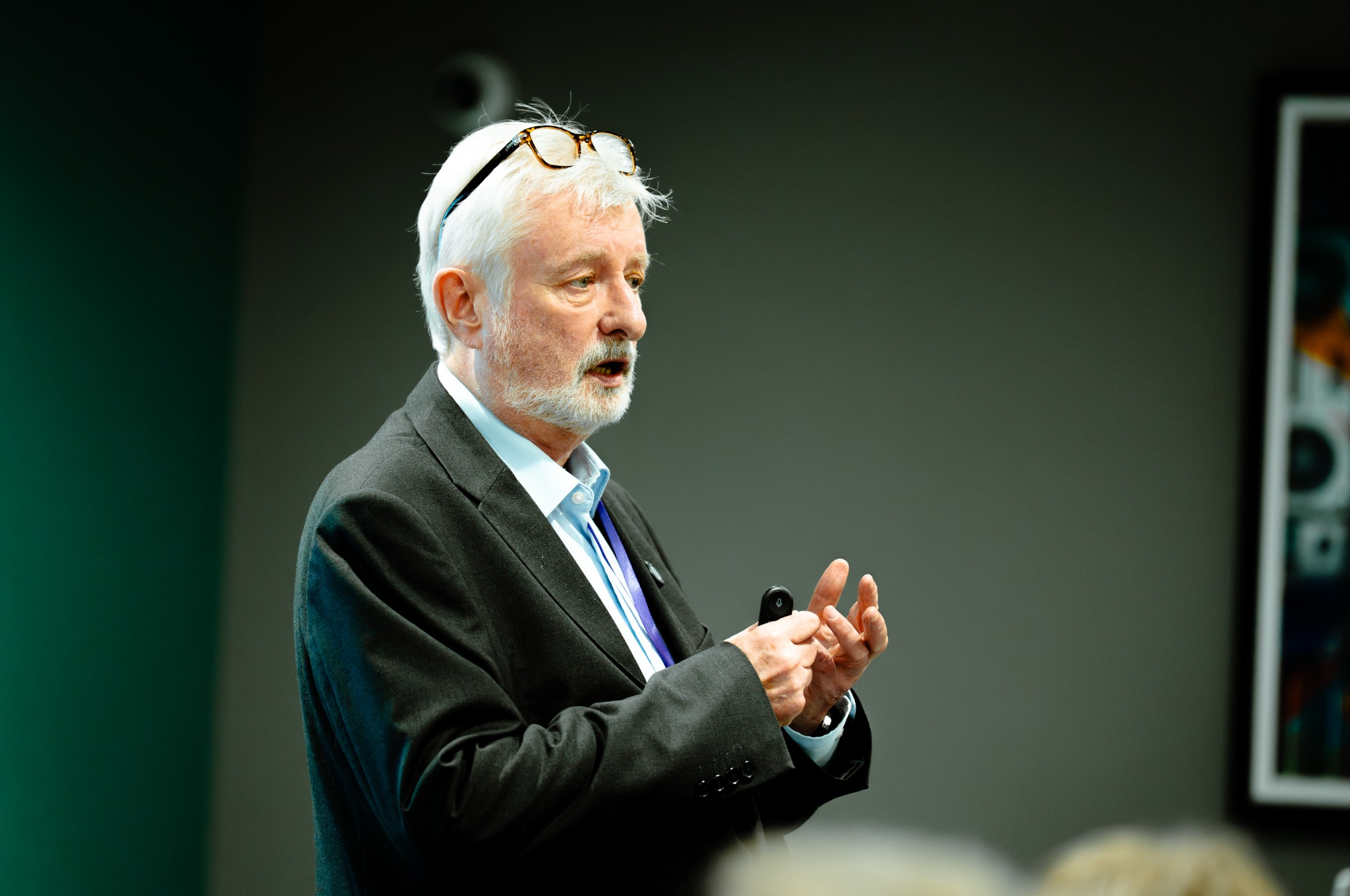
Former Chair of the Association for Project Management, with contributions to earned value guidance, project controls and professional standards. Featured in APMG’s earned value learning resources.

Author of the Managing Portfolios and Managing Benefits guides supporting APMG certifications, with senior Civil Service experience in portfolio decisions and benefits realisation.

Professor Amgad Badewi is CEO of Kent Business College and a former Reader of Project Controls and Management at Kent Business School. He completed his PhD at Cranfield University in 2016 and received APM’s Herbert Walton Award that year. His teaching connects project controls, governance and benefits management with research and professional practice.

Andrew is an Associate Professor of Project Management and Controls at KBC and a Chartered Project Professional. His career includes Eurofighter Typhoon development and leading QinetiQ’s global project management team. His expertise covers complex programmes, governance, assurance and capability development. He holds a postgraduate certificate from Alliance Manchester Business School.
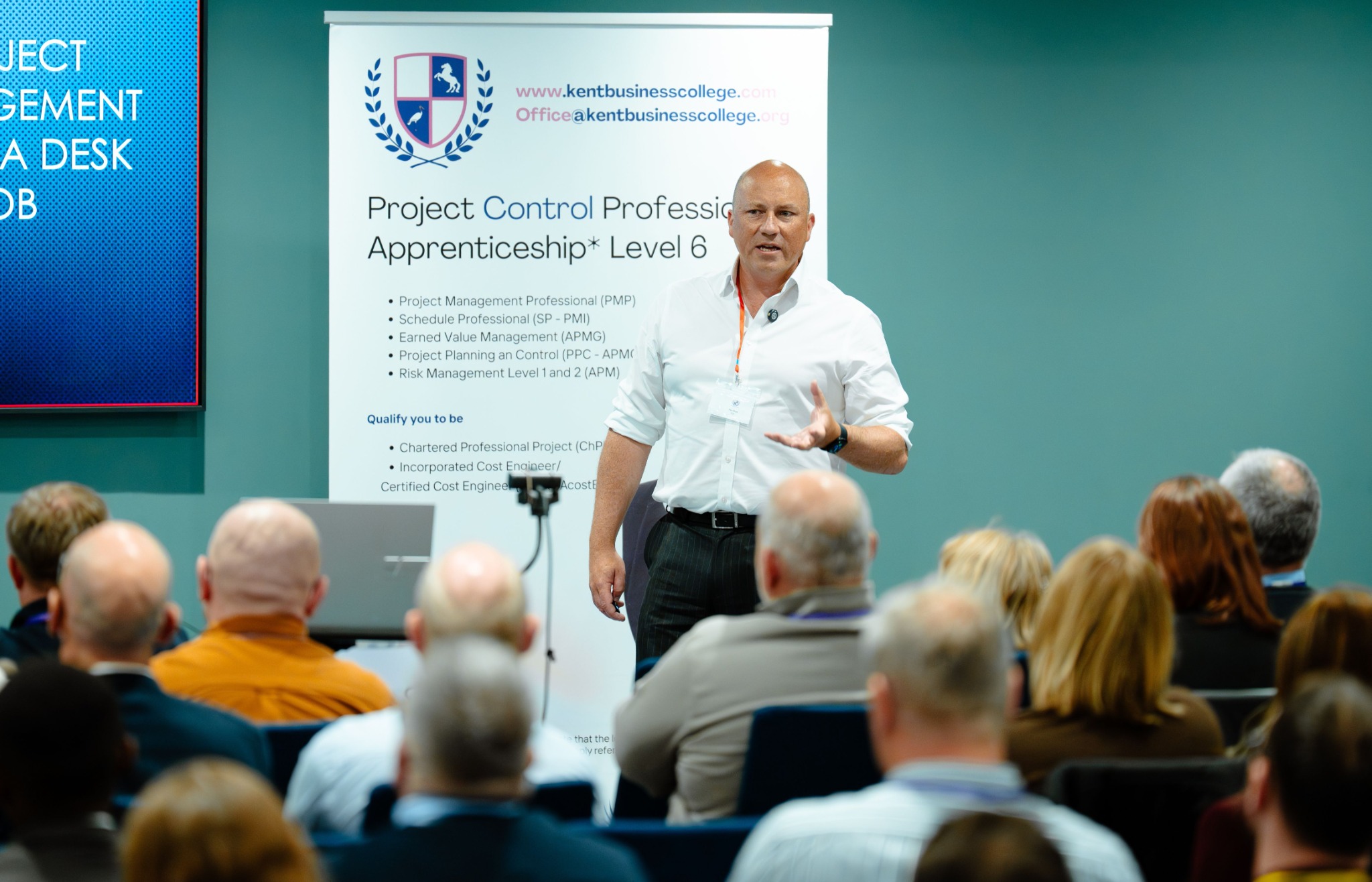
Ray is a Founding Partner of p3m global and co-author of Delivering Successful PMOs. He helps organisations develop project, programme and portfolio management capability through consultancy, training and delivery. His international experience includes IT and telecommunications. He also mentors project professionals through the Association for Project Management.
Project management, planning and professional development coaching.
Project management and workplace learning support.
Project management and evidence-development support.
Operations research and analytical learning support.
The programme team confirms your assigned tutors and coach. Coaching connects subject learning, workplace evidence, employer feedback and your development priorities.
Use tutoring, recordings, coaching and one-to-one sessions without an additional tutoring fee. Discuss a difficult topic, time-management barrier or need for another learning format.
Create a tailored support plan →Explore interests and personality through optional RIASEC and Big Five reflections. Add your professional experience and generate an AI-assisted career plan to review with your coach.
Open your career planner →Use regular wellbeing conversations and optional learning-needs tools. Know how to raise a concern about bullying, discrimination, exploitation or unsafe behaviour, and how to request adjustments.
Find safeguarding help →These tools support reflection and discussion; they do not diagnose a condition, decide admission or replace professional judgement. You can ask for help without completing a questionnaire.
These are an introduction to the checks, not the full eligibility rules. Meeting a single condition does not establish entitlement. Tell KBC about previous qualifications, overlapping study, employment changes or anything that may affect funding before signing.
Recognition of prior learning can change the content, duration, required hours and price where the applicable rules allow it. The team explains the outcome of the initial assessment and records the agreed plan. Your signed apprenticeship agreement, training plan, employer arrangements and written offer contain your individual terms.
If apprenticeship funding or employer-protected training time is unavailable, ask about the separate professional-learning route. This may be relevant to international applicants, people outside apprenticeship eligibility, unemployed or self-employed applicants, or professionals whose employer cannot support the apprenticeship commitment.
The published alternative IPC offer describes potential support of 50–75%, subject to an application, eligibility, available support and approval. You may be asked for an updated CV, a character statement, and an explanation of your goals, interests and intended impact. The written offer confirms any funding award and the remaining fee before you commit.
This is a separate commercial learning offer. It does not become a funded apprenticeship without eligible employment, employer support and the required paid training arrangements. Standalone course prices and inclusions are quoted separately; the £27,000 and £7,000 figures describe the complete PCP apprenticeship package.
Discuss an IPC-supported routeThe apprentice charter brings together attendance and flexible learning modes, monthly submissions, shared responsibilities, exam booking, safeguarding, Prevent, inclusion, complaints and quality feedback. Read it alongside the formal policies and individual agreements, and ask us to explain anything that is unclear.
Open the apprentice charter packJoin a programme information session, employer funding briefing or professional-recognition event to discuss your route. Contact office@kentbusinesscollege.org or 01622 958955.
Kent Business College Ltd is registered in England and Wales, company number 10367575. Your signed agreements identify the contracting party and individual terms. Programme information reviewed 10 September 2026; start-date rules, professional-body conditions and your confirmed offer apply.
Hear from learners on this programme, in their own words.

LA architects
Kent Business College tutors explain concepts clearly and deliver engaging sessions, ensuring that each topic is fully understood. The skills coach provides constructive feedback on my work and helps identify areas for improvement. Their ongoing guidance and support have helped me develop my Project Controls skills, build confidence, and make good progress throughout my apprenticeship.
MAG (Airports Group)
Overall, the apprenticeship is helping me become a more capable and confident project manager. It complements my practical experience by providing structured learning and recognised industry best practice that I can immediately apply in my role. The knowledge and skills I am gaining are already benefiting my day-to-day work and helping me develop professionally.

Nene Park Trust
I'm familiar with the topics covered so far, due to my previous experience; however, the training provides structure and context and places concepts into a formal, logical framework. I've already learnt so much more than I expected at this stage

Discuss your role, employer priorities, funding and the six-credit mix that will support your development.
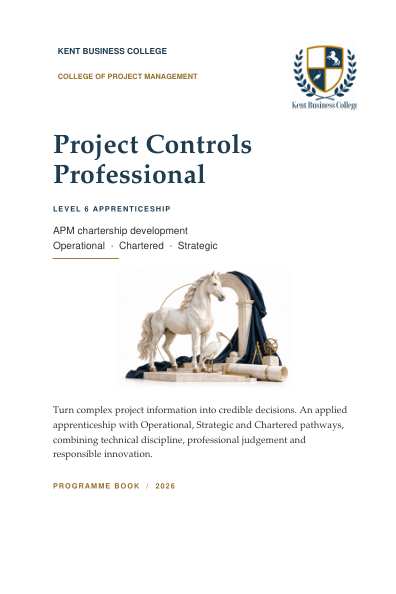
YOUR PROGRAMME BOOK
Operational, Chartered and Strategic pathways
Compare the three pathways and explore the curriculum, workplace evidence, assessment, professional progression and funding in the complete programme book.
99 pages · 2.0 MB · Cover and complete book included · Published by Kent Business College
FOR EMPLOYERS & LINE MANAGERS
Plan workplace learning, protect training time and support assessment with the complete programme guide. Eight chapters bring together your responsibilities, the curriculum, progress reviews, safeguarding and practical tools.
64 pages · 5.3 MB · September 2026 edition