Professional learning. Lasting impact.
Staff LoginLearner loginCareer plannerKBC communityLearner hub Employer loginPolicies & safeguarding
LONDON · 2 OCTOBER 2026

From learning
to lasting impact.

A day of ideas, professional insight and connection at The Cumberland. Explore the stories and questions at the heart of KBC’s London Masterclass.

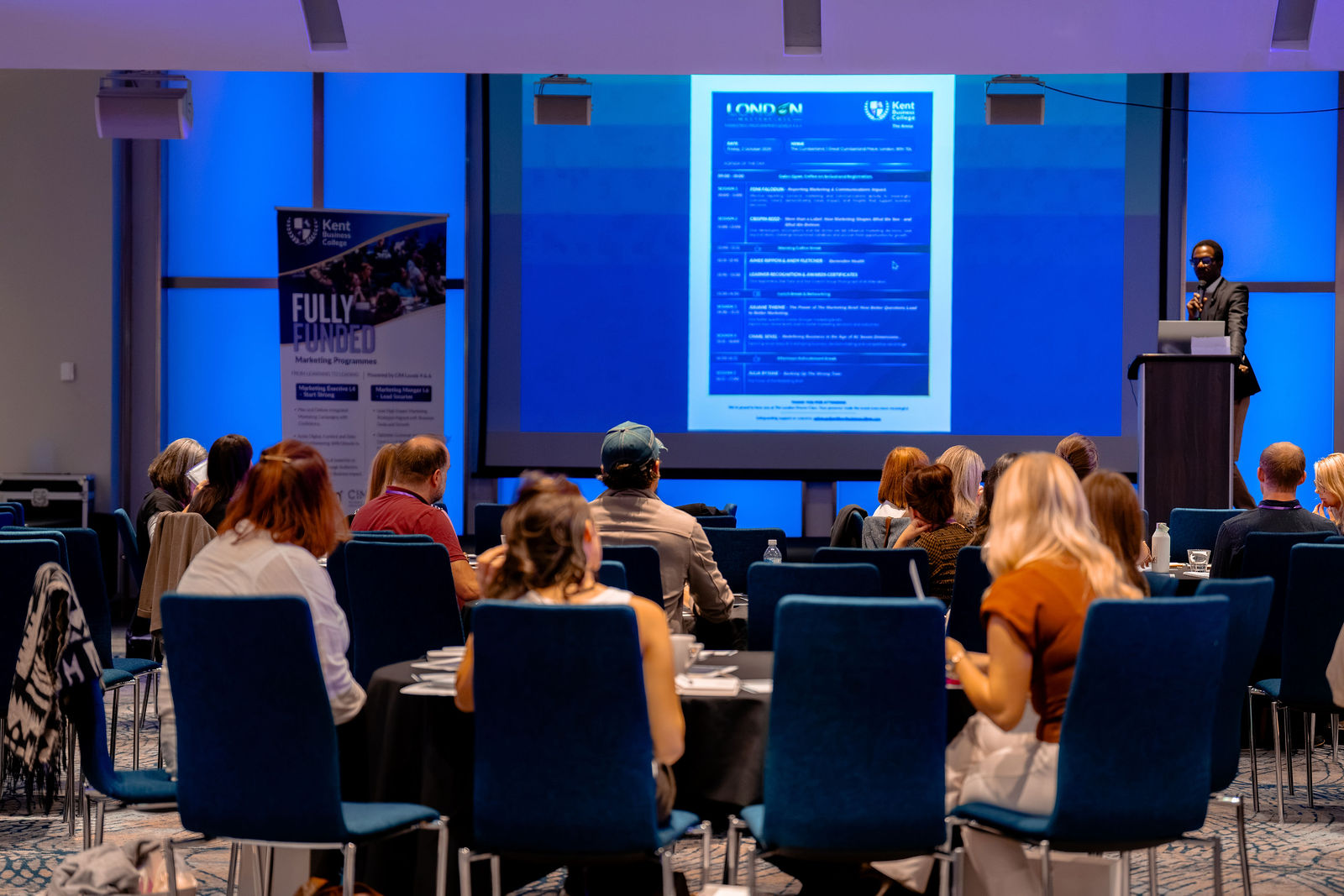
Delegates gathered for a presentation at the London Masterclass
The London Masterclass at The Cumberland · Photography: We Stream
The occasionLondon Masterclass
WhenFriday, 2 October 2026
WhereThe Cumberland, London
FromThe KBC community

On Friday, 2 October 2026, Kent Business College’s London Masterclass brought its professional learning community to The Cumberland, in the heart of the capital. The programme connected technical expertise with the questions that give it purpose: How do we make better decisions? How do we demonstrate value? How do we help people develop the confidence and judgement to make a difference at work?

Three strands gave the day its breadth. Project controls and project management occupied REMIX 1 & 2; the Marketing Programmes Levels 4 & 6 programme took place in The Arena; and the Employer Lounge in Studio 1 focused on turning apprenticeship learning into business impact. Shared time for recognition, lunch and networking connected these different professional perspectives.

That combination captures something central to KBC’s approach. An apprenticeship is a relationship between a learner, an employer and an education provider. Its value grows when all three understand what progress looks like and how learning can be applied. A masterclass offers a setting in which the bigger picture can come into focus alongside the detail of day-to-day practice.

Delegates signing in at Kent Business College’s London masterclass.
A welcome to the KBC learning community.
Delegates sharing ideas around the table.
Professional learning begins with a conversation.
THE EMPLOYER LOUNGE

Ideas worth revisiting.

Short excerpts from Amgad Badewi’s discussion of the relationship between people, organisational capability and business outcomes.

Read the selected clip transcript

These highlights are from the Employer Lounge. Use the programme below to explore the full day’s project controls and marketing sessions.

A programme built around better professional judgement

The day began with registration and welcome coffee from 09:00, before the first sessions at 10:00. Across the programme, a consistent thread emerged: professional knowledge becomes more valuable when people can use it to ask better questions, interpret evidence and influence action.

For project professionals, this meant considering plans, benefits, earned value, transformation and leadership. For marketers, it meant examining reporting, assumptions, briefs, artificial intelligence and the interpretation of data. For employers, it meant looking closely at the connection between a development programme and the capabilities an organisation needs.

These are distinct disciplines, but they meet in familiar workplace situations. A report may be accurate yet fail to help its reader decide. A project may deliver its planned outputs while its intended benefits remain uncertain. A campaign may generate activity without a clear account of its contribution. The London programme invited attention to the judgement that sits between information and action.

01 / THE SESSION GUIDE

Project controls: connecting information, delivery and value

The Project Control Professional Level 6 & APM Level 4 programme brought together five sessions and an industry contribution. Its sequence moved from the practical work of controls through benefits and performance measurement to transformation and the human realities of organisational change.

Emily Cooke

The Practical Side of Project Controls Delivery

Emily Cooke’s opening session, “The Practical Side of Project Controls Delivery”, set a clear direction. The agenda described effective project controls as the connection between accurate plans and data, clear insight, and better decisions. Risk response, accountability, collaboration and outcomes were all part of that connection.

This is a valuable starting point for developing professionals. The quality of a schedule or report matters, but so does its usefulness to the people responsible for delivery. Does it make an emerging issue visible? Does it help a team understand the consequences of a change? Can the reader identify what needs attention and who should act?

For learners, a useful follow-through is to choose one regular workplace report and examine how it supports a decision. Consider the audience, the uncertainty it should explain and the action it should enable. That exercise connects technical work with the practical purpose of project controls.

Stephen Jenner

Realising Benefits: Problems, Causes and Solutions

Stephen Jenner’s “Realising Benefits: Problems, Causes and Solutions” brought the programme to the question behind any investment in change: what improvement is it intended to produce? The agenda framed the session around the difficulties organisations face in realising the benefits of projects and programmes, the causes of those difficulties, and potential solutions, with examples from around the world.

The theme matters because delivery and benefit are related but different. Completing an activity is easier to observe than establishing whether it has changed an outcome in a useful and lasting way. Benefits thinking asks for clarity about what should improve, how that improvement will be recognised, and who needs to remain involved after an output has been delivered.

A practical reflection for learners and employers is to revisit a current initiative. Can its intended benefit be expressed in plain language? Is there an agreed starting point against which change can be assessed? Is someone responsible for helping that change become part of everyday practice? These questions help keep purpose visible throughout delivery.

Dawn Rossell

Controls & Skills Authority (C&SA)

The industry contribution from Dawn Rossell, representing the Controls & Skills Authority (C&SA), introduced a membership body for project control professionals. Its place in the programme linked classroom and workplace development with the wider professional community.

That wider community is an important part of a developing career. Learning can continue through professional discussion, exposure to different organisations and contact with people who have encountered similar challenges in other settings. It also helps learners see their own work as part of an established discipline with shared questions and evolving practice.

For someone building a career in project controls, the useful question is straightforward: where can I continue the professional conversation beyond my immediate team?

Steve Wake

EV or Not EV? That Is the Question

After lunch, Steve Wake’s “EV or Not EV? That Is the Question” introduced the principles and reasons for using Earned Value Management. The programme promised an overview supported by practical insight and experience.

Earned value invites a disciplined conversation about progress. It brings planned work, completed work and cost into a connected view, helping teams examine what delivery information is actually telling them. Its usefulness depends on the quality of the underlying definitions and evidence, as well as the way results are explained.

For learners, the reflective starting point is the meaning of “complete”. How does the organisation establish that work has been achieved? Is progress based on evidence that different people would interpret consistently? Are the measures helping the team ask useful questions about future delivery? These are worthwhile considerations before any performance figure becomes part of a management conversation.

Amgad Badewi

Author Spotlight: Project Control in Transformational Projects

Amgad Badewi’s “Author Spotlight: Project Control in Transformational Projects” placed project control within the wider setting of transformation. The title brought together two concerns that can be difficult to hold in balance: the need for disciplined delivery and the need to understand how an organisation is changing.

Transformation involves people making sense of new expectations, working practices and priorities. Technical information remains essential, while its interpretation needs to take account of the environment in which change is happening. This makes the relationship between controls, strategy and adoption a productive area for professional reflection.

One question to carry forward is whether a project’s reporting makes the desired organisational change visible. Alongside milestones and expenditure, what evidence helps the team understand whether new ways of working are taking hold? Thinking about that relationship helps connect project control with the purpose of transformation.

Andrew Millington

The Zero Authority Paradox

The final project session, Andrew Millington’s “The Zero Authority Paradox”, addressed leadership in complex organisations, culture and political awareness. The programme highlighted navigating organisational structures, building a network and overcoming resistance to change.

This theme speaks directly to professional life. The ability to contribute is not always matched by formal authority. People often need cooperation from colleagues whose priorities differ from their own, and a technically sound recommendation still needs to be understood and accepted.

For learners, leadership development can begin with a small, practical map of a current challenge: who is affected, whose knowledge is needed, and what matters to each person? A thoughtful conversation with the right colleague can reveal a constraint that a report alone would miss. The session’s place at the close of the strand underlined how closely technical practice and human relationships are connected.

02 / THE SESSION GUIDE

Marketing: asking clearer questions and making stronger decisions

The Arena programme offered a complementary exploration of professional judgement. Its five sessions considered how marketing demonstrates impact, how assumptions shape interpretation, and how better questions can improve both creative and analytical decisions.

Femi Falodun

Reporting Marketing & Communications Impact

Femi Falodun’s “Reporting Marketing & Communications Impact” opened the marketing strand with a focus on meaningful outcomes. The agenda described reporting that demonstrates value, impact and insight in ways that support business decisions.

For developing marketers, reporting is an opportunity to explain the significance of their work. An account of activity becomes more useful when the reader can understand what it contributed, what remains uncertain and what should happen next. Choosing what to include requires a clear view of the audience and the purpose of the report.

A useful workplace exercise is to review a recent campaign summary and ask what decision it enables. Can a colleague see why the findings matter? Is the intended outcome clear? Does the report distinguish what the evidence shows from the interpretation being offered? Those questions can make reporting a stronger part of ongoing learning.

Crispin Reed

More Than a Label: How Marketing Shapes What We See - and What We Believe

Crispin Reed’s “More Than a Label: How Marketing Shapes What We See - and What We Believe” invited attention to the assumptions behind marketing decisions. The programme described stereotypes, established narratives and the stories that influence what people see, alongside opportunities that may become visible when those labels are questioned.

This is an important theme for a profession that regularly describes audiences. Categories can make information easier to organise, but the people within them may have different motivations, experiences and needs. A familiar description can become less useful when it goes unexamined.

For learners and employers, one productive next step is to revisit a commonly used audience description. What evidence supports it? Whose experience might it overlook? What would change if the team approached the audience with a fresh question? The value lies in creating room for curiosity within an otherwise familiar planning process.

Aimee Rippon & Andy Fletcher

Benenden Health

The guest contribution from Aimee Rippon and Andy Fletcher of Benenden Health added a further professional perspective to the marketing programme before the shared recognition period.

Guest contributions broaden the range of contexts learners can encounter during a programme. They provide a prompt to consider how professional ideas relate to organisations with different audiences, priorities and services. The agenda’s inclusion of Benenden Health also sat alongside a day that gave space to people and their development, as well as technical practice.

Juliane Thieme

The Power of the Marketing Brief: How Better Questions Lead to Better Marketing

Juliane Thieme’s “The Power of the Marketing Brief: How Better Questions Lead to Better Marketing” began the afternoon marketing sessions. Its focus was clear: stronger questions can produce clearer briefs, supporting better decisions and outcomes.

A brief is a meeting point between an organisation’s intention and the work needed to act on it. When objectives, audiences or expectations are unclear, that uncertainty can travel through the rest of a project. Careful questioning at the beginning gives a team a shared basis for making choices.

The practical reflection is to read a current brief through the eyes of someone encountering it for the first time. Is the problem understandable? Is the intended response clear? Are there assumptions that need discussion before work begins? A short conversation at this stage may improve the quality of everything that follows.

Charl Sevel

Redefining Business in the Age of AI: Seven Dimensions

Charl Sevel’s “Redefining Business in the Age of AI: Seven Dimensions” introduced the programme’s explicit focus on artificial intelligence. The agenda described seven ways in which AI is reshaping business, decision-making and competitive advantage.

For marketing learners and managers, this subject raises practical questions about purpose and judgement. The presence of a new tool does not by itself establish where it will be useful. A team needs to understand the work being considered, the quality required and the responsibilities that remain with people.

An appropriate workplace reflection is to identify one clearly defined task and consider where assistance could be useful. What would a good result look like? How would it be checked? Which decisions require human understanding of the audience, the context or the organisation? These questions can help a team approach experimentation with a clearer sense of value.

Julia Bysshe

Barking Up the Wrong Tree: The Use and Abuse of Data in Marketing

Julia Bysshe’s “Barking Up the Wrong Tree: The Use and Abuse of Data in Marketing” closed the marketing strand with a title that placed interpretation under scrutiny.

Data becomes useful through the questions asked of it. A figure can be accurately recorded while still being misunderstood, taken out of context or asked to support a conclusion beyond its limits. Professional judgement involves being attentive to definitions, comparisons and the relationship between the evidence and the claim.

For learners, a valuable habit is to pause before presenting a striking result. What does the measure actually describe? What comparison makes sense? What other explanation might fit? These questions connect naturally with the day’s opening focus on reporting impact and bring the marketing programme back to the importance of clear, credible communication.

03 / THE EMPLOYER PERSPECTIVE

The Employer Lounge:
from training to business impact

The Employer Lounge featured “From Training to Business Impact: Maximising the Value of Apprenticeships”, scheduled from 10:00 to 12:00. Its stated focus was practical workplace improvement, stronger performance and long-term business value.

In the recorded Employer Lounge presentation, Amgad Badewi connects apprenticeship learning with business capability. The material distinguishes organisational capability from individual competence and considers skills gaps, project management and project controls, marketing pathways, career fit and an employer diagnostic demonstration.

This provides a useful bridge between the specialist strands. A learner may be developing a particular competence, such as interpreting project information or preparing a marketing brief. The employer’s wider concern is how that developing competence contributes to a capability the organisation needs: more reliable delivery, clearer decisions, stronger communication or a more effective response to change.

The distinction encourages a more purposeful development conversation. The starting point becomes an organisational need and the work through which learning can be applied. The learner and manager can then discuss where practice is possible, what support is available and what evidence would indicate progress.

The diagnostic demonstration brings that conversation into a practical format. A structured assessment can provide a starting point for discussing strengths, development priorities and the fit between a programme and workplace responsibilities. Its value grows when the results lead to an informed conversation and a realistic development plan.

For employers, three questions are especially useful: What does the business need to become better at? Where can the apprentice contribute while learning? How will the manager, learner and provider review progress together? Those questions help connect programme participation with everyday work and make development a shared responsibility.

04 / OUR COMMUNITY

Recognition belongs at the heart of professional learning

The shared programme reserved 12:45–13:30 for Learner Recognition & Awards, including Star Apprentice, Star Tutor and Star Coach, followed by a group photograph. Lunch and networking ran from 13:30 to 14:30.

These moments belong at the centre of an apprenticeship community. Learner progress involves sustained effort alongside workplace responsibilities. Tutors help make demanding ideas accessible and relevant. Coaches create space for reflection, planning and a continuing conversation about development.

Recognising those different contributions acknowledges how professional learning happens. It is supported through explanation, encouragement, challenge and the steady work of applying something new. Employers and colleagues also have an important role in creating opportunities for that application.

The presentation photographs capture that recognition in a personal way: certificates held with pride, congratulations shared and applause around the room. Together, these moments celebrate the commitment behind professional progress and the people who support it.

AWARDS & RECOGNITION

Moments to be proud of.

Celebrating achievement, commitment and the people behind professional learning.

FRIDAY, 2 OCTOBER 2026

A day with purpose.

The official London Masterclass programme.

Download the full agenda (PDF)
Project controls & project management
  • Emily CookeThe Practical Side of Project Controls Delivery
  • Stephen JennerRealising Benefits: Problems, Causes and Solutions
  • Dawn RossellControls & Skills Authority (C&SA)
  • Steve WakeEV or Not EV? That Is the Question
  • Amgad BadewiAuthor Spotlight: Project Control in Transformational Projects
  • Andrew MillingtonThe Zero Authority Paradox
Marketing programmes Levels 4 & 6
  • Femi FalodunReporting Marketing & Communications Impact
  • Crispin ReedMore Than a Label: How Marketing Shapes What We See – and What We Believe
  • Aimee Rippon & Andy FletcherBenenden Health
  • Juliane ThiemeThe Power of the Marketing Brief: How Better Questions Lead to Better Marketing
  • Charl SevelRedefining Business in the Age of AI: Seven Dimensions
  • Julia ByssheBarking Up the Wrong Tree: The Use and Abuse of Data in Marketing
Employer Lounge & shared moments
  • Registration & welcome coffeeAcross the event
  • Employer LoungeFrom Training to Business Impact: Maximising the Value of Apprenticeships
  • Learner Recognition & AwardsStar Apprentice · Star Tutor · Star Coach · Group photograph
  • Lunch & networkingConnecting the KBC community
WHAT COMES NEXT

Take one idea.
Put it to work.

The most useful next step after a wide-ranging learning day is often a focused one. A learner might improve the question at the top of a report, clarify how progress is evidenced, revisit an audience assumption or arrange a conversation about a development priority.

For managers, a short follow-up conversation can help that intention become practical. Ask which idea connects most closely to current work, where the learner could try it and what support would help. Agreeing a small application and a review point creates continuity between the event and the apprenticeship programme.

Across project controls, marketing and employer development, the London Masterclass’s themes point towards a shared ambition: people who understand their work, question it thoughtfully and can explain the value of what they do.

Conversations over coffee at the London masterclass.
The conversation continues beyond the session.

Kent Business College thanks the speakers, guest contributors, learners, employers, tutors, coaches and colleagues who were part of the London Masterclass. We are proud to create opportunities for professional expertise and learning to meet — and we look forward to seeing these conversations continue in workplaces, coaching meetings and classrooms.

Session names, speakers and timings follow the official KBC event programme. The video excerpts are from the Employer Lounge recording. Workplace questions are KBC editorial reflections on the programme themes. Photography is credited to We Stream.