

Introduction to safeguarding and Prevent in apprenticeships
Purpose, duties, age and provider scope, roles and the apprenticeship safeguarding ecology.
Open this chapter in the book (PDF opens in a new tab)Chapter introduction and learning outcomes
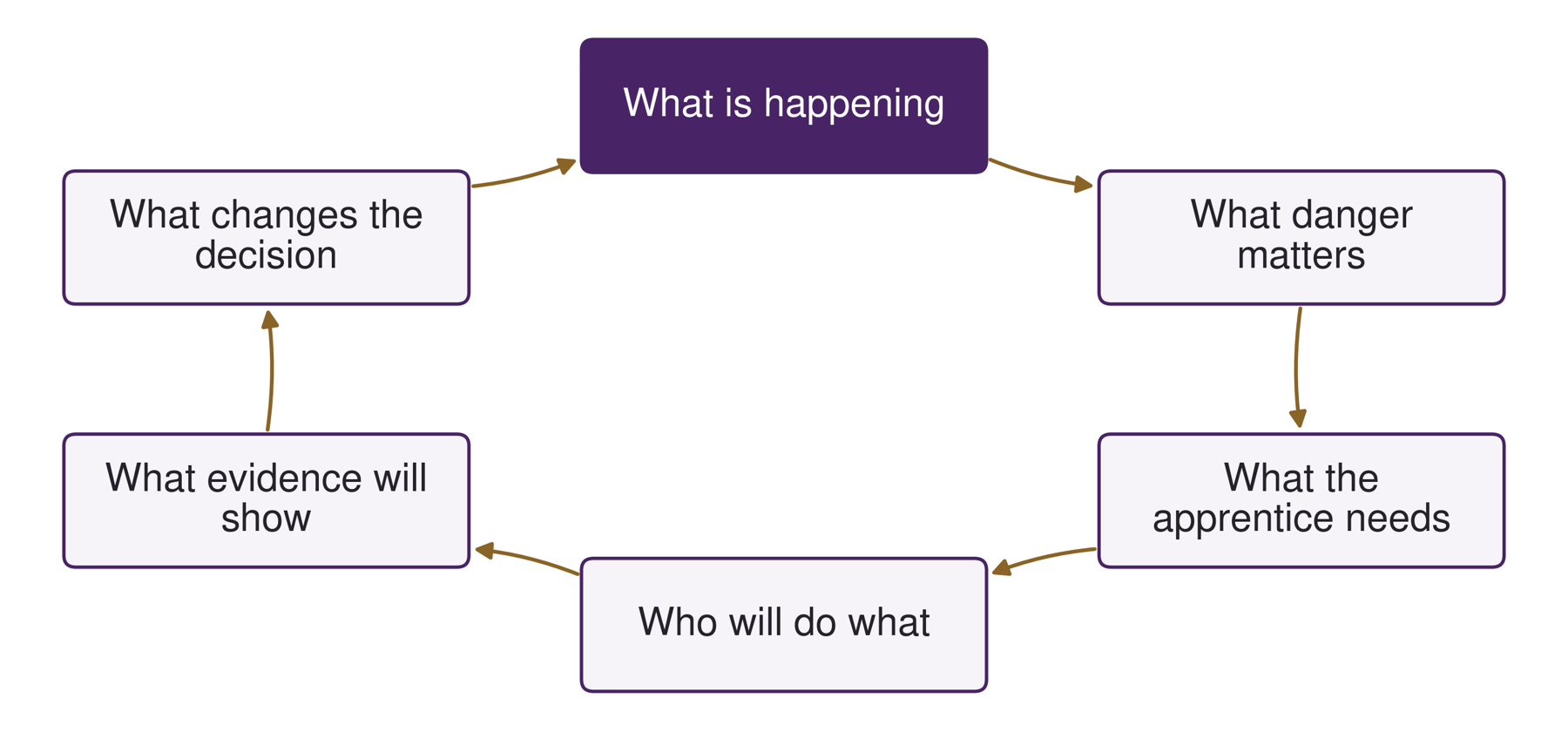
Safeguarding begins with what happens when an apprentice needs help. A reassuring policy has little value if a learner cannot speak privately, a coach mistakes fear for poor motivation, or a referral disappears between organisations. This handbook connects recognition, professional judgement and practical action across the places where apprentices learn and work. It is written for England, with an editorial review date of 9 September 2026.
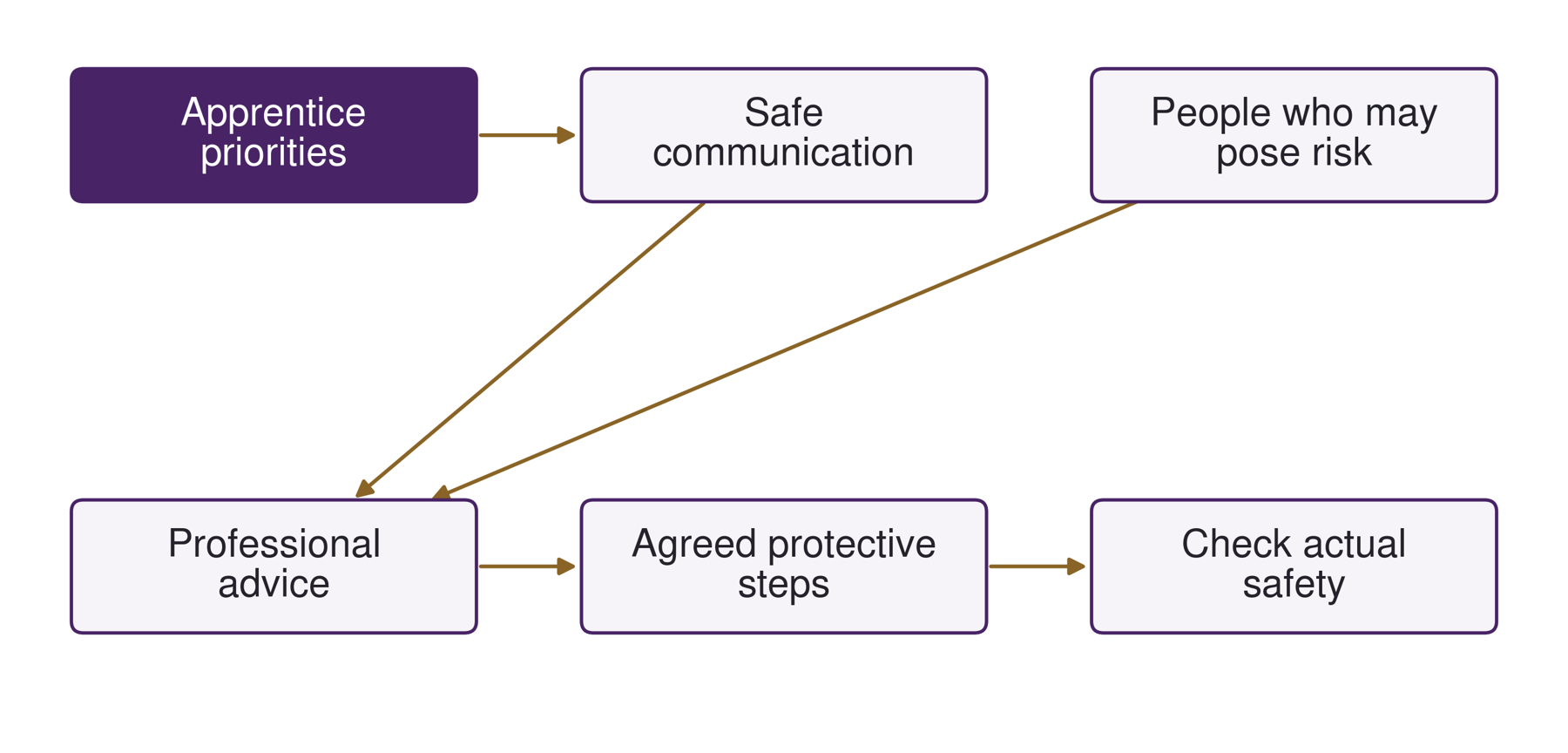
After studying this chapter, readers should be able to distinguish safeguarding, child protection, adult safeguarding and Prevent; identify their own responsibilities and their limits; select an appropriate first response; and explain what evidence would demonstrate that an apprentice is safer. Readers should understand how provider plans relate to statutory agency decisions.
1.1 Why safeguarding belongs at the centre of apprenticeship qualitybook p. 2
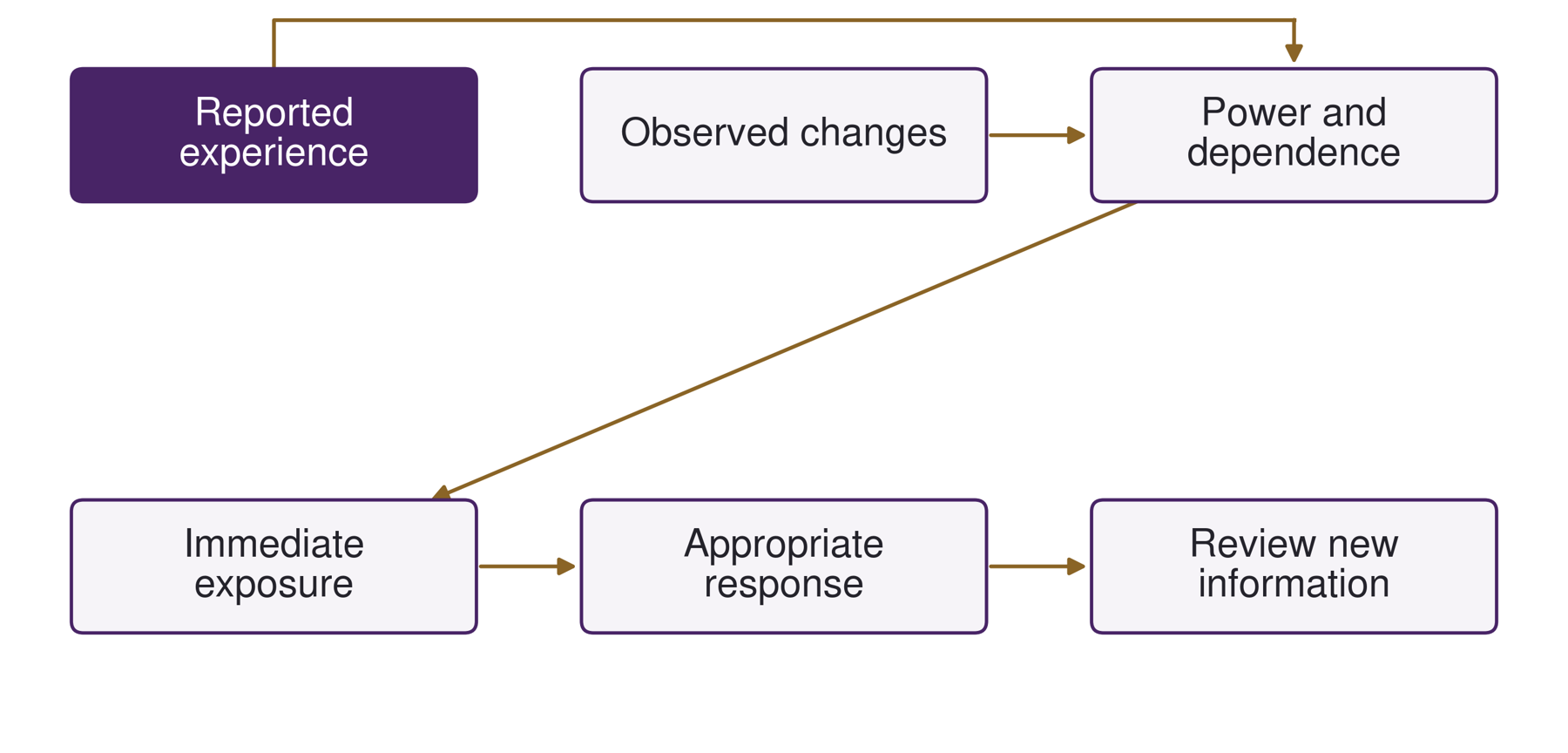
An apprenticeship combines employment, professional learning and assessment. Each creates opportunities, but their combination can also make asking for help difficult. A learner may fear that reporting a supervisor will cost them their job, that missing a shift will prevent completion, or that disclosing a personal problem will change how colleagues treat them. The person assessing their competence may also be the person who controls access to valuable workplace experience. Safety therefore depends partly on how power is organised.
Consider a learner who repeatedly cancels a review. Several explanations are possible: an unreliable connection, an employer who will not release them, caring responsibilities, dissatisfaction with teaching, or intimidation. A safeguarding approach does not label every cancellation abuse. It creates a reliable opportunity to understand the barrier before imposing a response that could worsen it. Educational ambition and safeguarding judgement work together when the provider asks both what the apprentice needs to learn and what is preventing safe participation.
The provider guide requires safety and welfare arrangements for all apprentices and clear procedures for concerns arising in employment or personal life. It also connects ineffective safeguarding with contractual intervention. Responsibility for this guidance moved to the Department for Work and Pensions on 1 April 2026. [001]
It does not confer investigative powers, qualify a coach as a clinician, replace local procedures or promise an inspection result. A competent practitioner can say that a situation exceeds their expertise while still taking ownership of the next safe step. The practitioner should recognise and respond to what needs attention now.
book p. 2 (PDF opens in a new tab)1.2 Four connected ideas with different purposesbook pp. 2–3
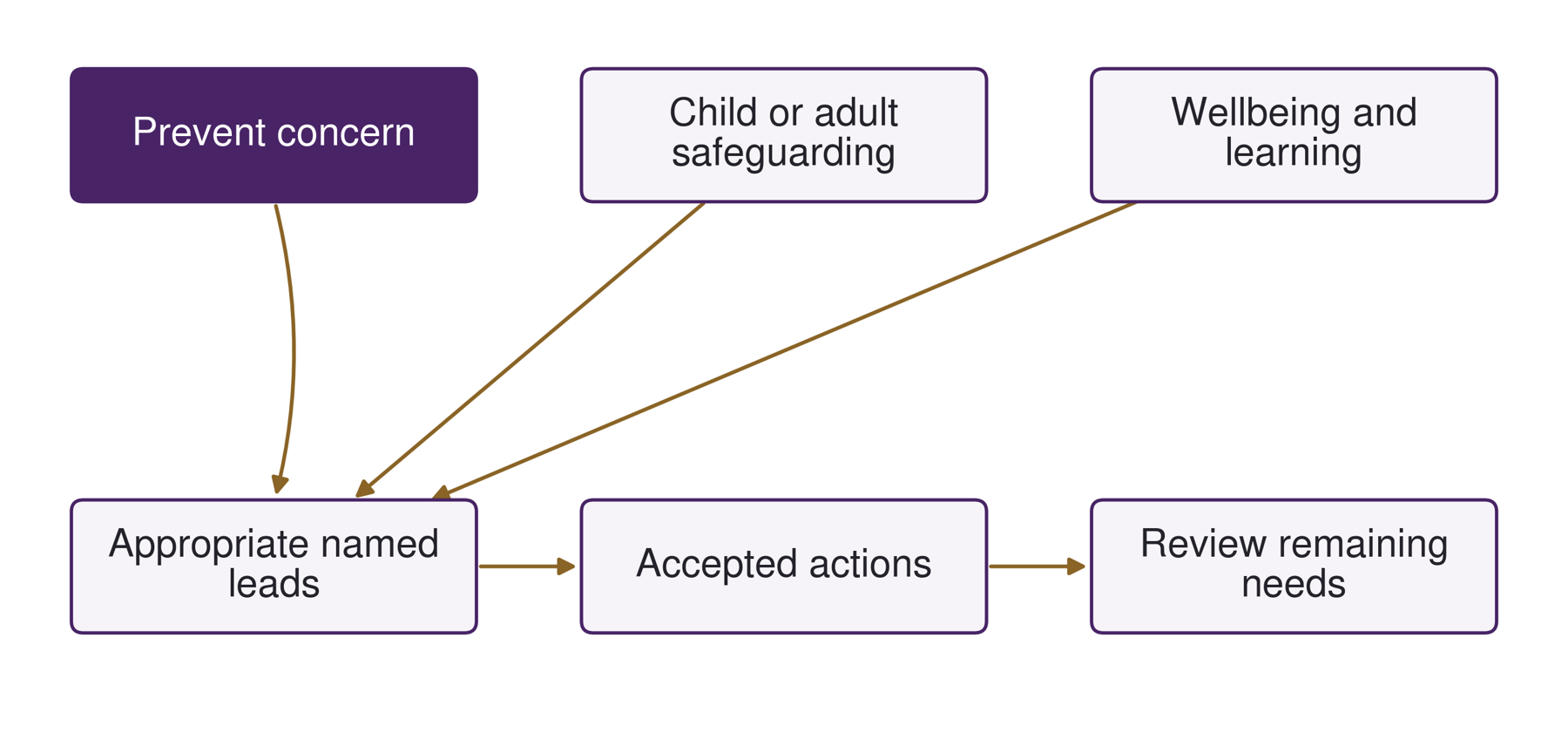
Safeguarding is the broad work of creating safe conditions, noticing emerging needs and responding to harm. It includes organisational decisions made before any individual concern arises: recruitment, accessible reporting, employer oversight, digital design, staff conduct and a curriculum that helps learners understand their rights. Child protection is the more specific response when a child is suffering, or is likely to suffer, significant harm. Working Together distinguishes these purposes within a system of early help, support and protection. [002]
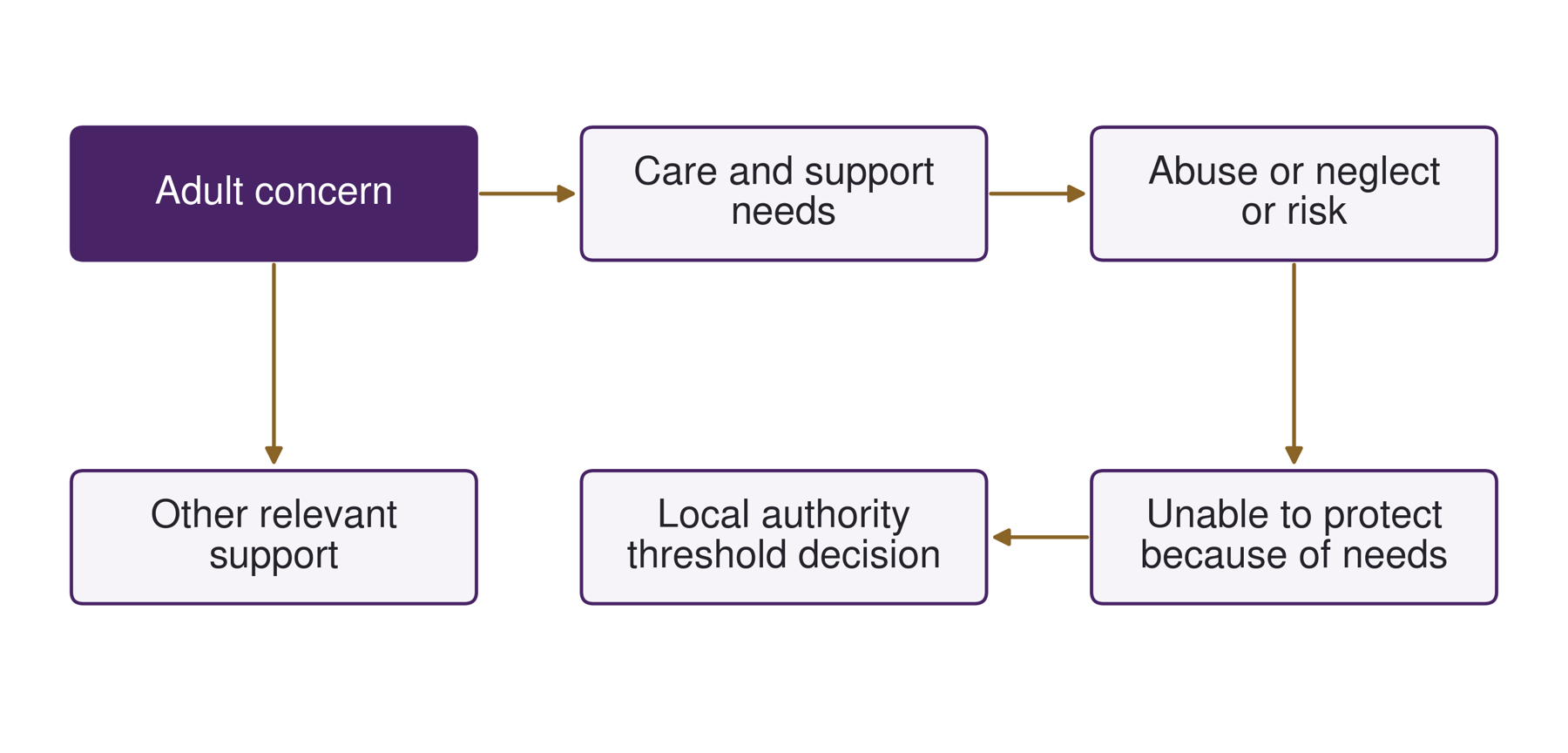
Adult safeguarding has a particular statutory meaning. The Care Act framework concerns an adult with care and support needs who experiences, or risks, abuse or neglect and, because of those needs, cannot protect themselves. The three conditions belong together. A learner can require urgent assistance without their situation necessarily meeting that framework. The local authority determines its enquiry responsibilities; a coach should describe the concern and seek appropriate advice rather than attempt to rule the person in or out alone. [003]
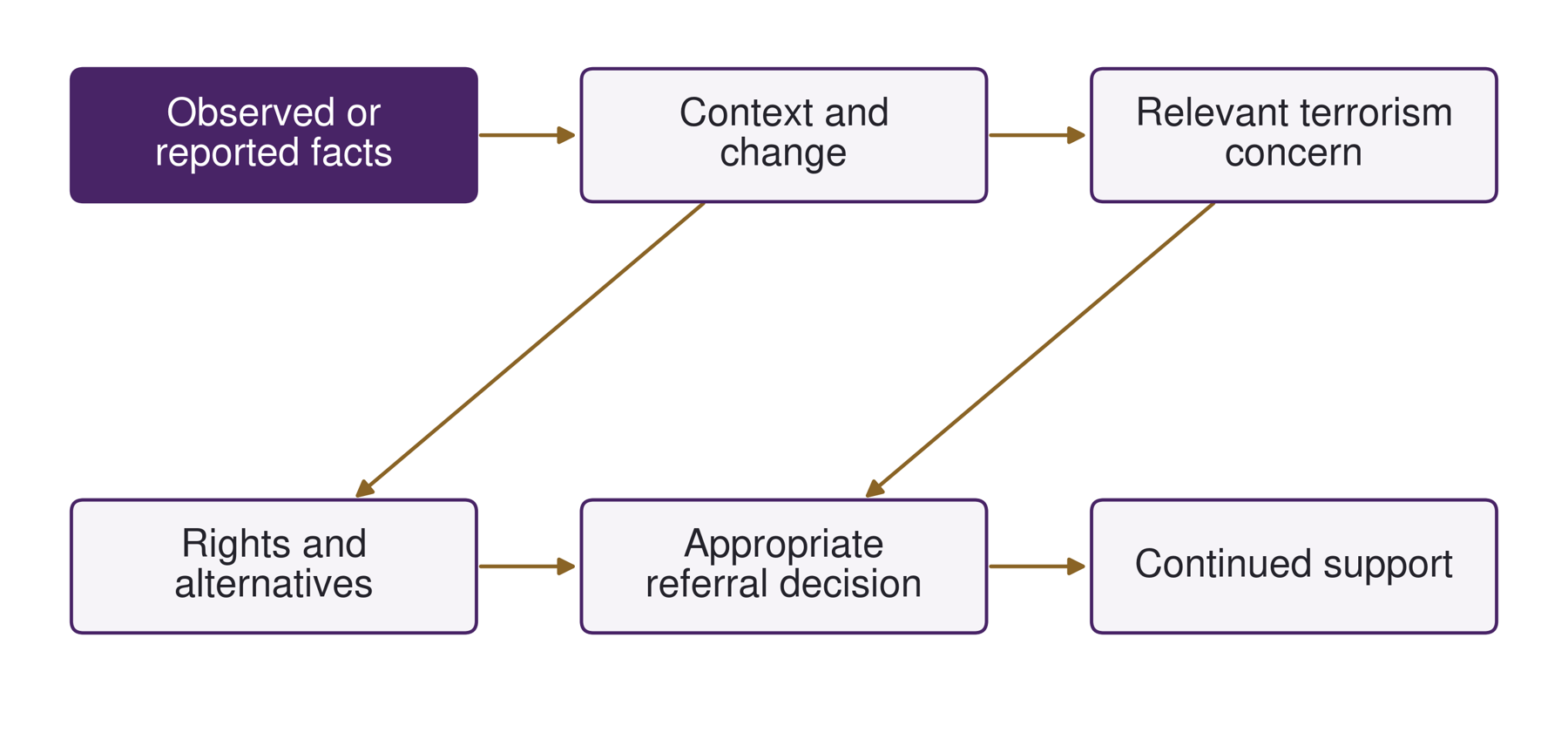
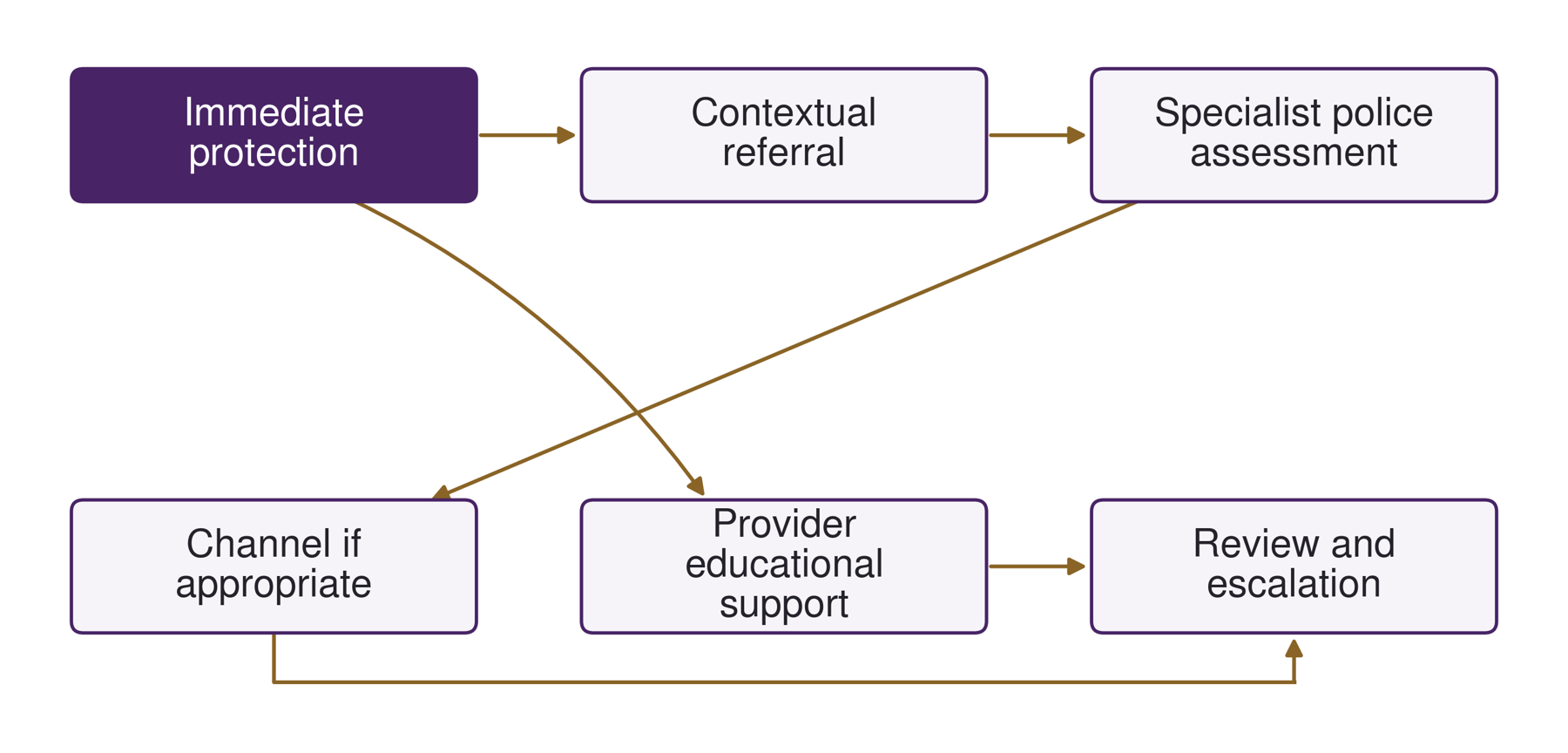
Prevent concerns the risk of people becoming terrorists or supporting terrorism. It is one component of counter-terrorism and operates alongside wider safeguarding. A learning provider must distinguish this purpose from disagreement, unpopular beliefs, mental distress or a need for ordinary pastoral support. The specialist Prevent chapters explain how to assess context and use referral routes without treating identity as evidence. [004]
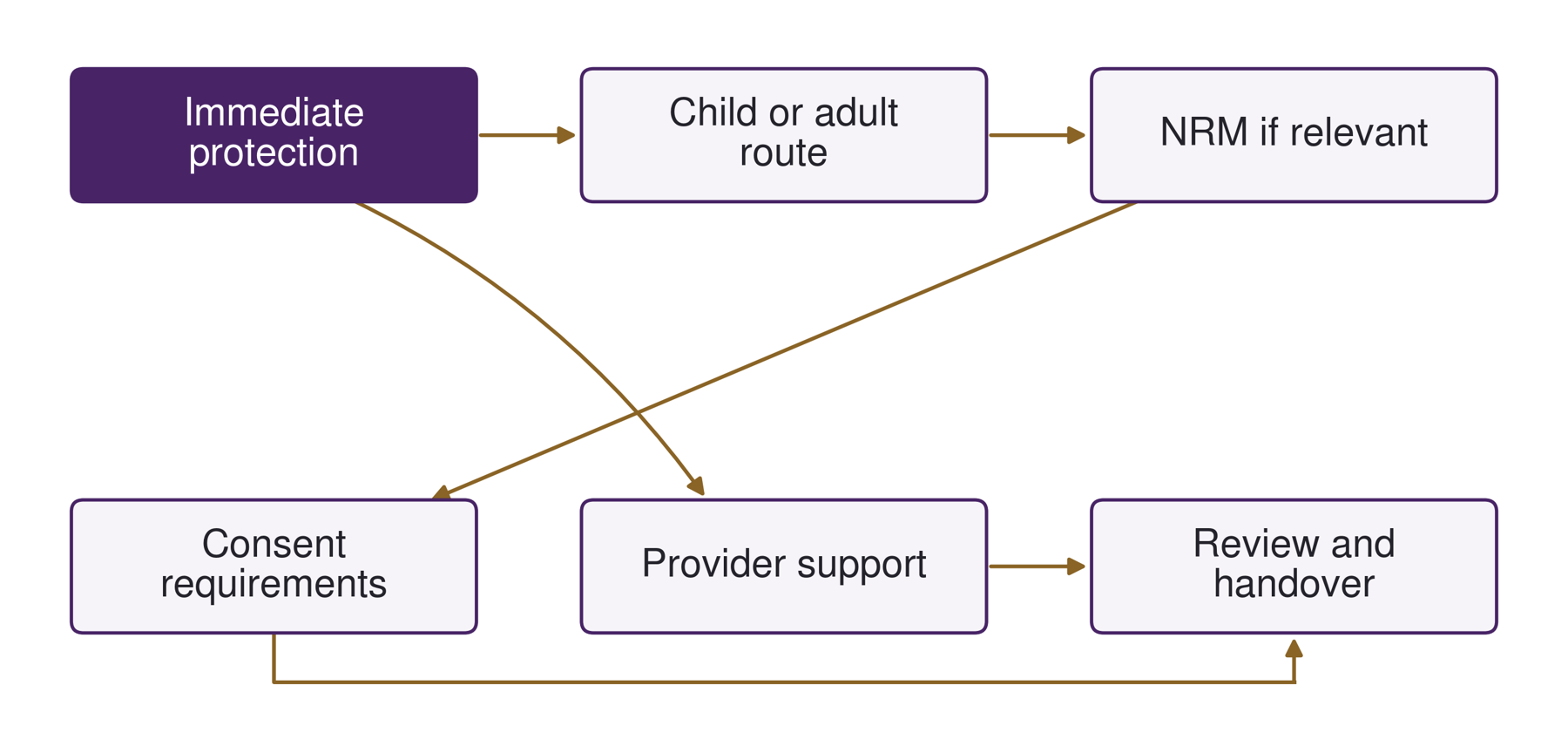
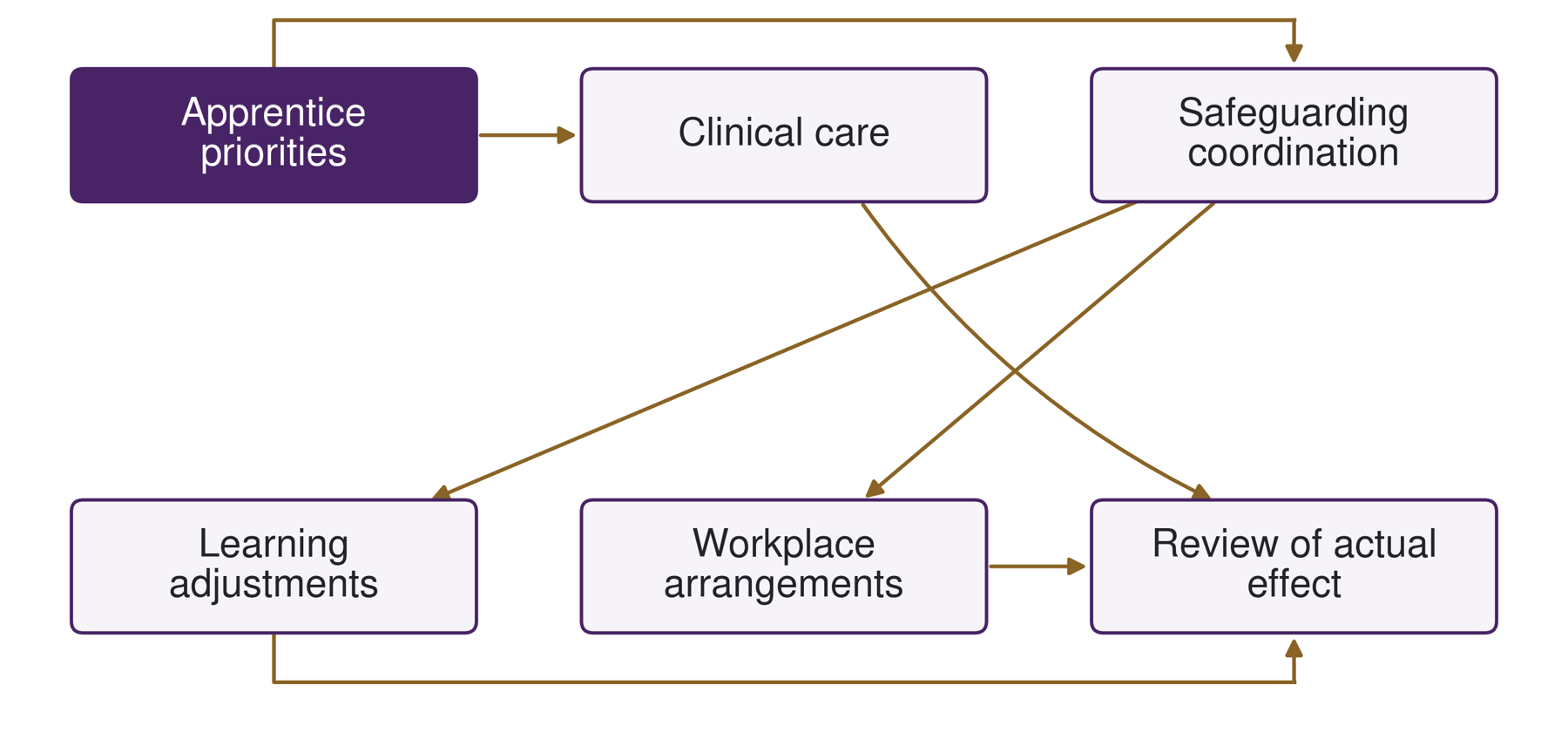
These distinctions prevent two opposite mistakes. The first is under-response: treating a credible threat as a routine learning issue. The second is overreach: treating every welfare difficulty as a statutory investigation. Appropriate support may involve several routes at once. For example, an exploited learner might need emergency protection, employment advice, a learning adjustment and specialist support.
book pp. 2–3 (PDF opens in a new tab)1.3 The apprenticeship safeguarding ecologybook pp. 3–4
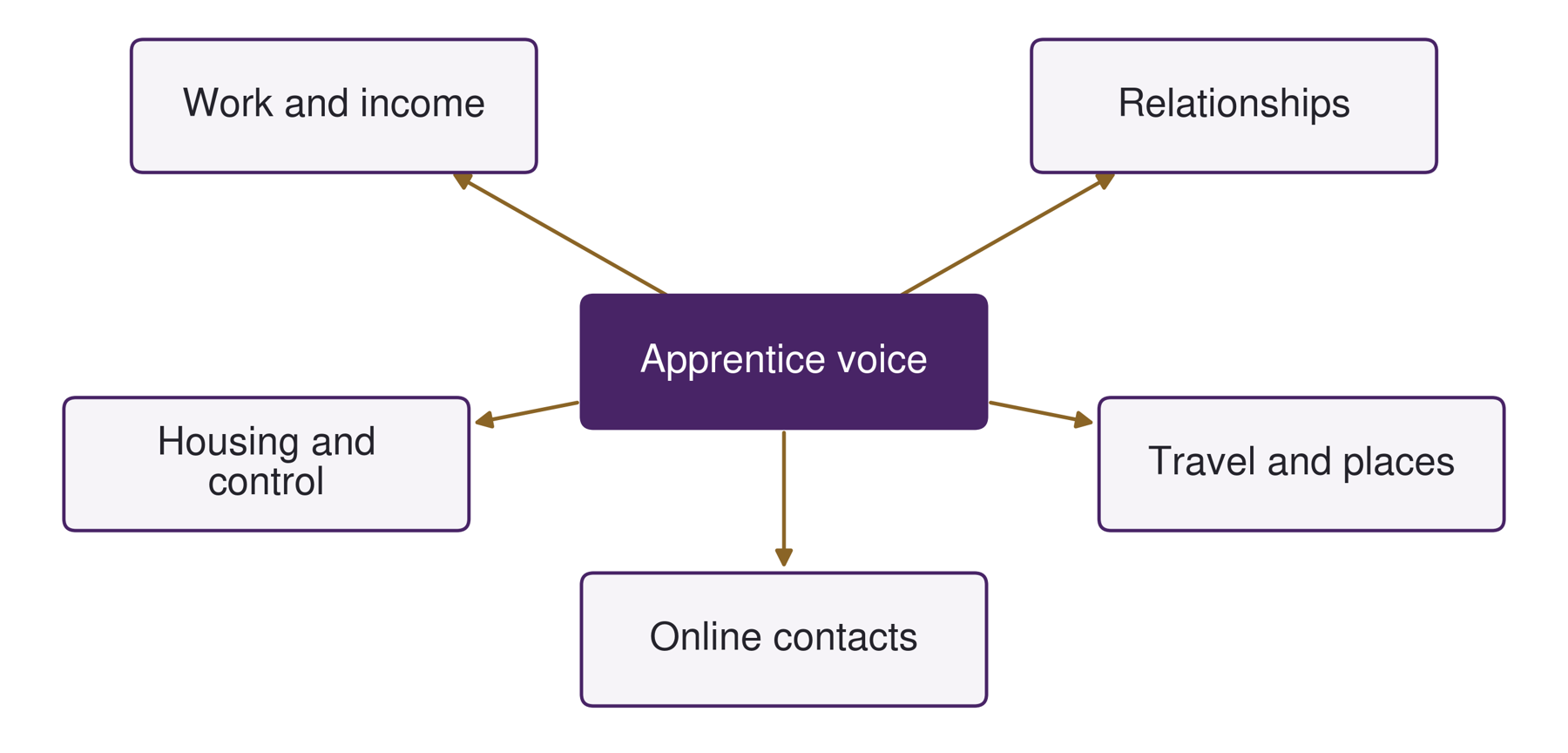
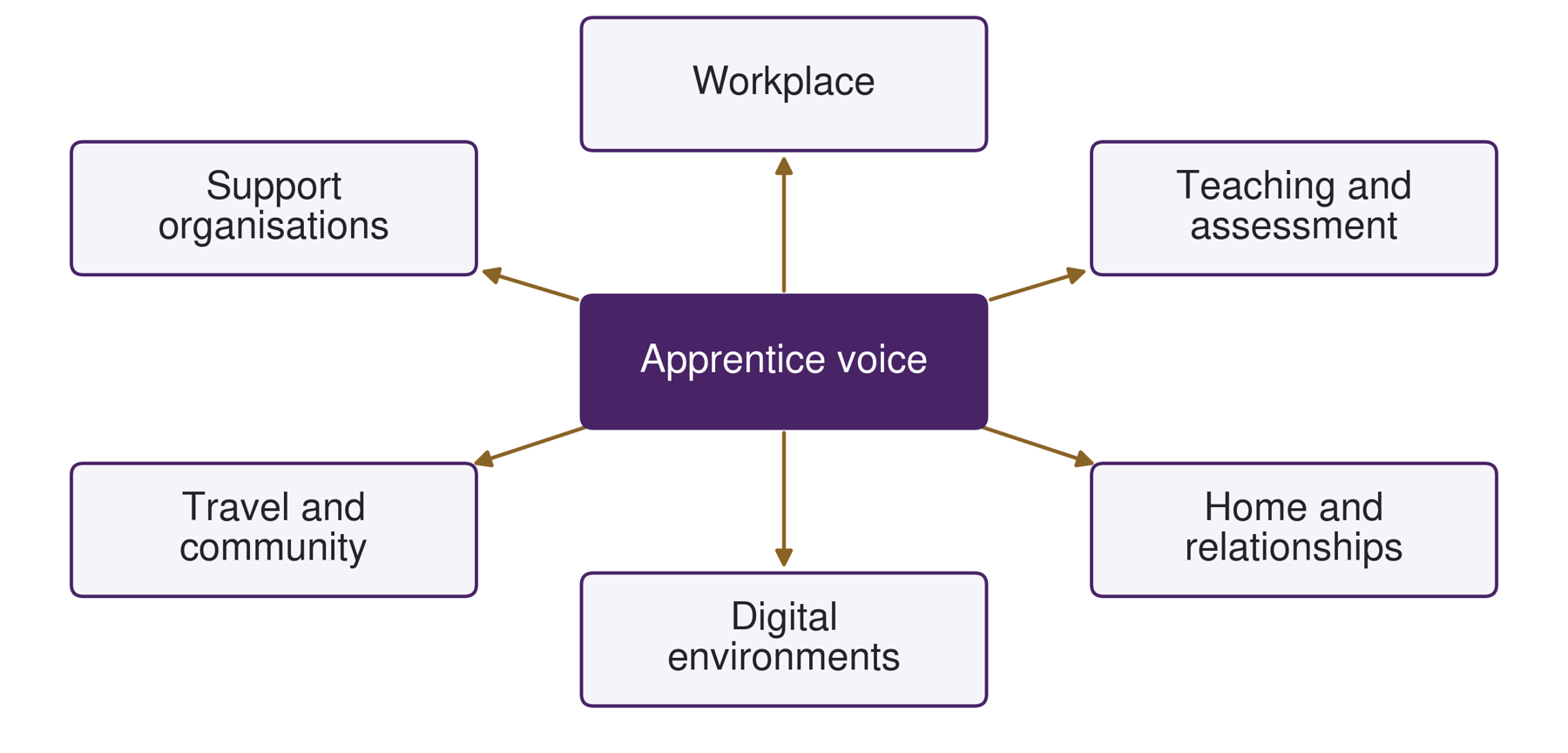
The KBC apprenticeship ecology is a practice aid for mapping where safety can improve or deteriorate. It is not a validated risk scale. Place the apprentice at the centre and examine six surrounding settings: the workplace; teaching and assessment; home and relationships; digital environments; travel and community; and the organisations making decisions about support. Ask where the concern occurs, who can change that environment, and what information is missing.
A provider might control a virtual classroom but not an employer's rota. It can still establish release arrangements, challenge repeated obstruction and reconsider whether a placement supports safe learning. A coach cannot control a public transport route, but can discuss practical alternatives and bring a pattern of harassment to the attention of appropriate partners. Mapping control prevents action plans from assigning tasks to people who cannot deliver them.
Add a second dimension: time. Risks may change during recruitment, induction, probation, a site transfer, an assessment setback, a relationship breakdown or the transition into adult services. A plan that was sensible before a supervisor changed may no longer work. The provider should also consider evenings, weekends and breaks in learning. Publishing a reporting address that is only monitored during office hours requires a clear explanation of what someone should do when urgent help is needed outside those hours.
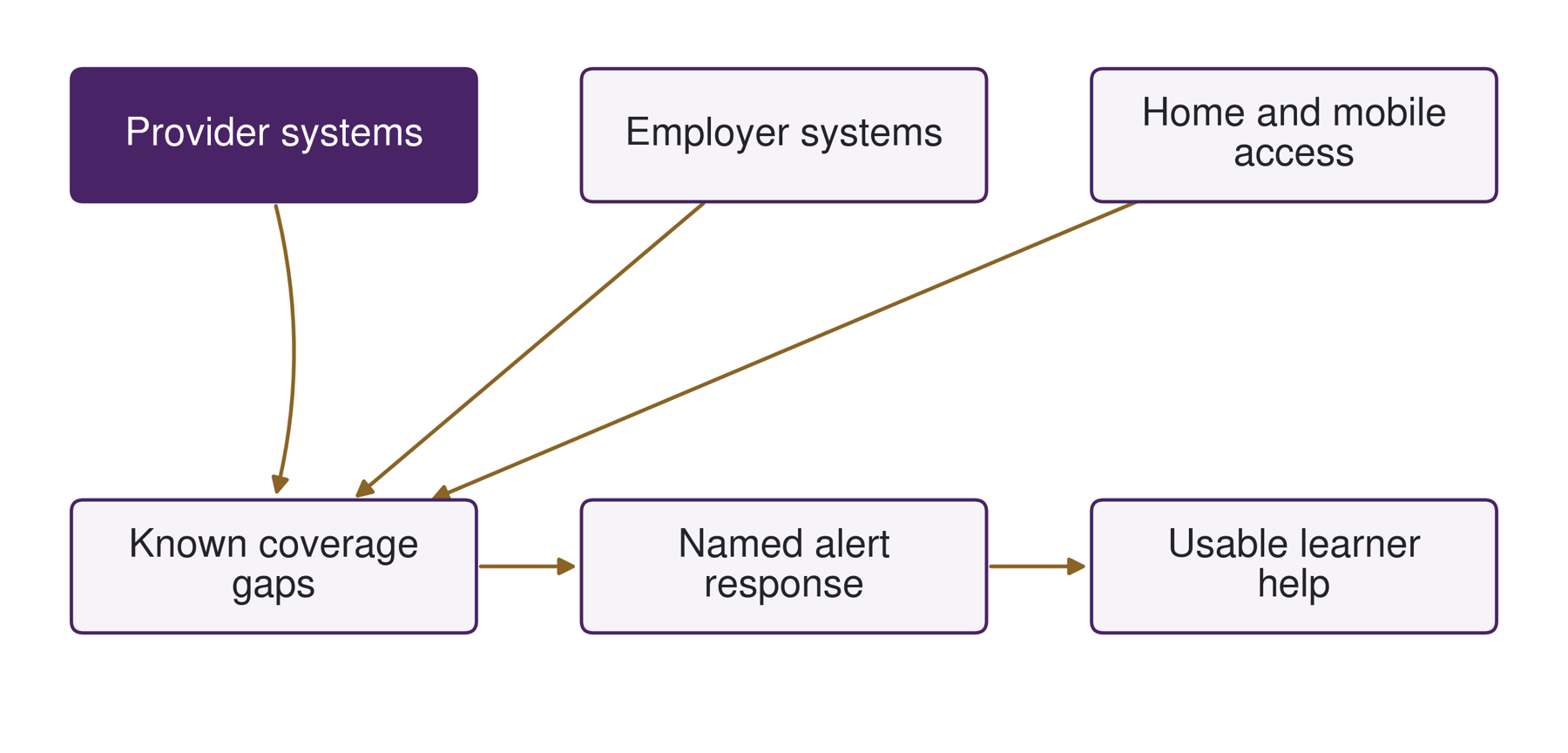
Finally, map dependencies. If a learner needs a private review, who supplies the room, releases them from work and confirms it happened? If a subcontractor receives a concern, who checks that the lead provider knows what it needs to know? A plan becomes more reliable when these connections are explicit. Reason's systems perspective supports looking beyond individual mistakes to the conditions and defences surrounding them; applying that idea to apprenticeships is a reasoned adaptation. [005]
1.4 Understanding duties without turning every rule into the same rulebook p. 4
Providers should maintain a short applicability record identifying their legal entity, funding arrangements, learner ages, delivery partners and relevant regulatory responsibilities. A further education corporation, an independent training provider and a university delivering apprenticeships do not have identical legal structures. A mixed provider may have different requirements across its activities. The record helps leaders obtain the right advice and prevents staff from copying another organisation's policy without checking its assumptions.
Keeping Children Safe in Education 2026 is in force from 1 September 2026. Its safeguarding scope includes relevant independent training providers within its definition of colleges. However, its recruitment footnotes distinguish requirements for different provider types. Leaders should check those qualifications rather than assume that every statutory requirement applying to a school applies identically to an ITP. [006]
This edition also separates current duties from forthcoming changes. The Crime and Policing Act 2026 contains a new child sexual abuse reporting framework. The Home Office confirmed on 7 September 2026 that this duty comes into effect in 2027. Enactment is not the same as commencement. Providers should prepare for the change while continuing existing prompt safeguarding referrals. [007] [008]
Use three labels in internal guidance: legal requirement, official expectation, and provider operational standard. A provider may choose a tighter administrative response target than national guidance specifies, but should identify it as its own standard. That makes accountability clearer and avoids presenting a locally chosen deadline as statute. Administrative targets must never turn an urgent response into permission to wait.
Assign a named owner to monitor changes, record their significance and check implementation. Updating a policy date is only the beginning. A meaningful update might require a different induction explanation, a change to recruitment checks, a revised data process or a new exercise in supervision. The test is whether staff can explain what they now do differently.
book p. 4 (PDF opens in a new tab)1.5 Age adulthood and continuitybook pp. 4–5
A person under 18 remains a child for safeguarding purposes even when employed, living independently, supporting a family or presenting confidently. Adult responsibilities can conceal an unmet need for protection. Equally, a 30-year-old apprentice should not be treated as a child because they need help with reading or communicate differently. Age, disability, employment status and decision-making ability are separate questions. [006]
The eighteenth birthday is a transition point, not an instruction to close support. Before a young person reaches it, identify what will change in agency involvement, communication and consent arrangements. Agree who will help them understand the change. A continuing learning adjustment may stay in place while a statutory service route changes. The provider should record the distinction so that staff do not confuse a change of administrative category with a reduction in need.
For adults, start by asking what they want to happen and what they are worried might happen if information is shared. A confident refusal of one proposed service is not proof that there is no concern. Conversely, a diagnosis is not proof that the learner cannot decide. Where decision-making ability is genuinely in question, use the appropriate specialist process; the coach's role is to explain observed difficulties and communication needs rather than assign a global label.
A useful transition conversation asks four practical questions. Who can the learner contact? Which people may receive which information? Which actions remain unfinished? What event would require renewed escalation? Record the answers in accessible language and confirm understanding. A handover is incomplete when information has merely been sent; someone must know who has accepted responsibility for the next action.
book pp. 4–5 (PDF opens in a new tab)1.6 Prevent rights and proportionate professional judgementbook p. 5
Prevent applies across age groups in settings within its statutory scope. It should be integrated into the provider's wider safeguarding arrangements while retaining a clear focus on radicalisation towards terrorism. Staff need routes for advice, not a homemade checklist that turns religious practice, political criticism, disability or social isolation into a prediction of dangerousness. The guidance also requires attention to equality and, in further and higher education, freedom of speech and academic freedom. [004]
In a classroom, a learner may express an argument that another learner finds offensive. The tutor may need to address respectful participation, discrimination or harassment. That does not automatically establish a Prevent concern. The tutor should distinguish what was actually said, its context, whether there was targeting or intimidation, and whether there is information indicating a risk connected with terrorism. Staff should not search for a politically convenient label when another established response fits the evidence.
The same discipline applies in the opposite direction. A concern does not cease to matter because the person appears articulate, successful or socially connected. Staff should take a credible threat seriously whatever the speaker's identity. When uncertainty persists, seek advice through the safeguarding and Prevent arrangements and record the reasoning. A referral is not a finding of wrongdoing, and a person receiving support should not be presented to colleagues as a confirmed extremist.
Chapters 9 and 10 examine the distinction between recognition, consultation, referral and Channel support. This opening chapter establishes the governing principle: protect people while preserving the rights that good education exists to support. Precision is essential to both aims.
book p. 5 (PDF opens in a new tab)1.7 Who must do whatbook pp. 5–6
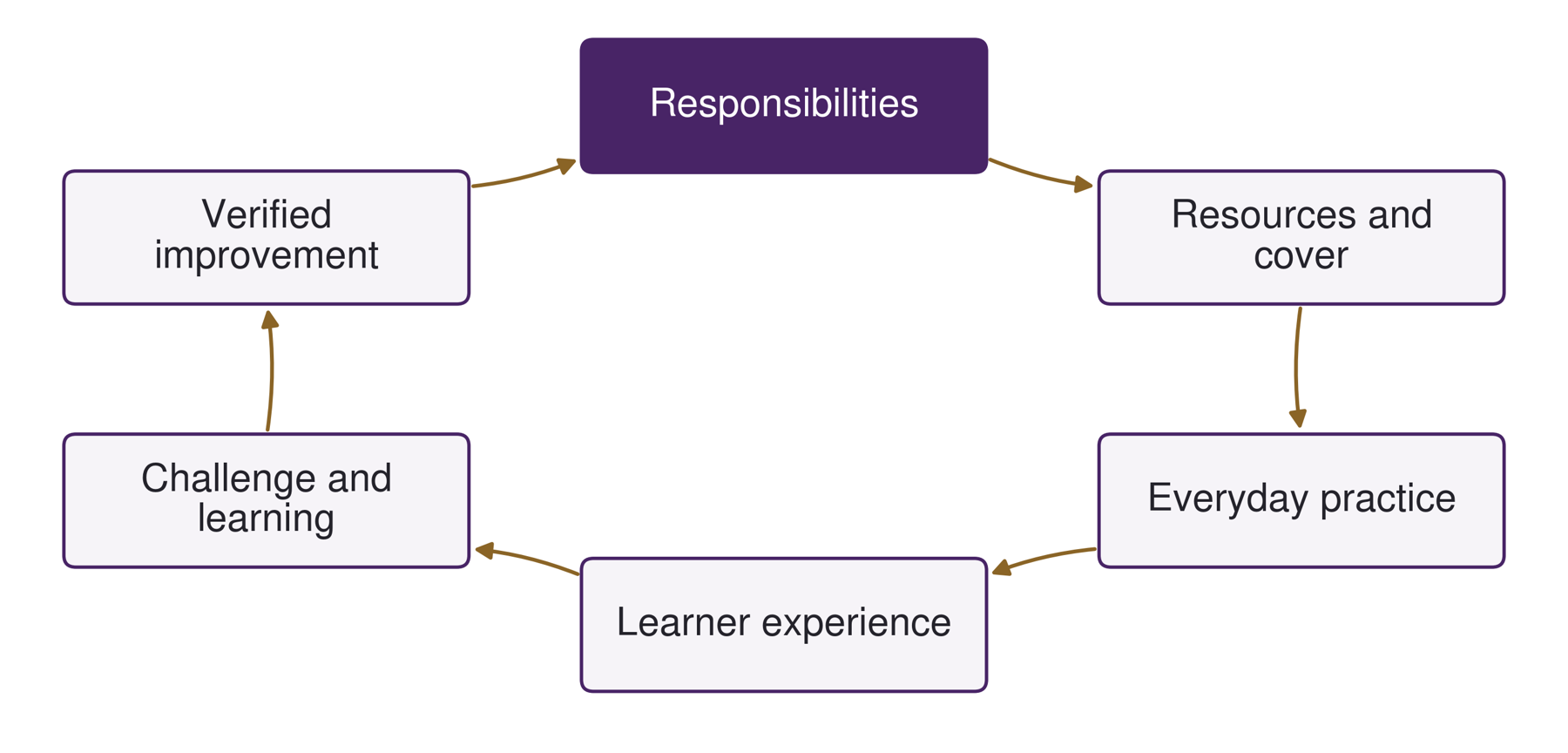
Safeguarding needs shared participation and clear accountability. Saying that it belongs to everyone is unhelpful if nobody knows who must complete a particular task. The following allocation is a KBC practice model; providers should adapt titles and responsibilities to their structure.
| Role | Main contribution | Boundary to maintain |
|---|---|---|
| Coach or tutor | Notice changes, listen, report, maintain appropriate learning support and follow up allocated actions | Do not investigate, diagnose or promise secrecy |
| Designated safeguarding lead and deputies | Coordinate triage, referrals, information decisions, oversight and escalation | Do not substitute provider judgement for statutory agencies' powers |
| Employer and workplace mentor | Provide safe work, respond to agreed concerns and protect access to learning | Do not insist that a learner reports only through their line manager |
| Curriculum team | Sequence relevant safety learning and connect it with occupational situations | Do not use personal disclosure as evidence of achievement |
| Design and technology teams | Make information, reporting and learning tools accessible, usable and secure | Do not build unnecessary collection of sensitive case details into learning systems |
| Senior leaders and governors or oversight body | Provide capacity, challenge decisions and evaluate actual experience and outcomes | Do not let commercial or reputational interests suppress concerns |
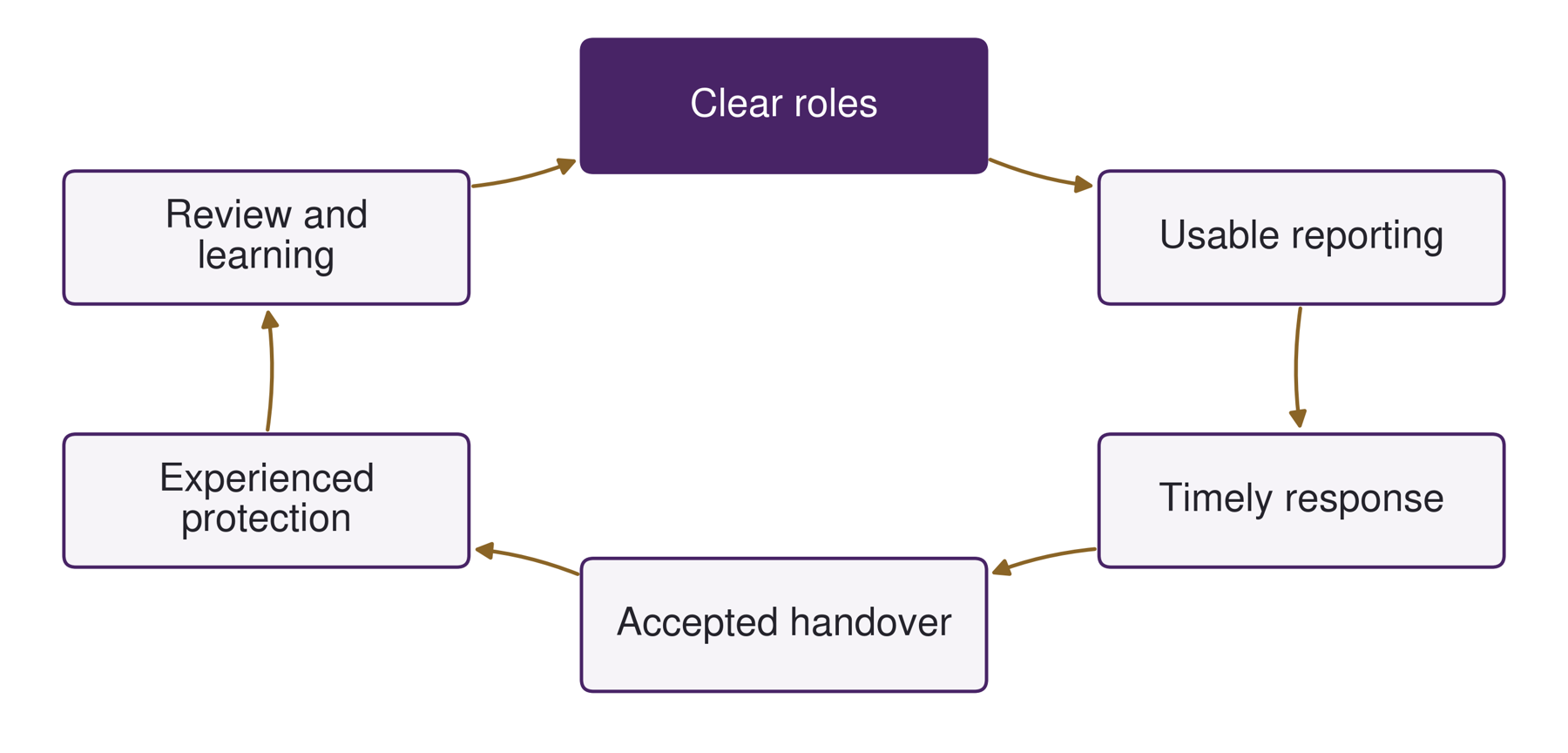
The first person told remains responsible for taking the next appropriate step until a safe handover occurs. This does not mean they become the permanent case manager. It means they know whether their message was received and what to do if the expected response fails. Deputies and escalation routes protect continuity when the usual lead is absent or implicated.
Every relationship with an employer or subcontractor should establish how concerns travel between organisations, who can act immediately and how disagreements are escalated. The agreement should also describe what is unnecessary to share. An employer may need to know that a temporary change to working arrangements is required without receiving the learner's full personal history.
book pp. 5–6 (PDF opens in a new tab)1.8 A culture in which learners can speakbook pp. 6–7
Does a tutor respect a request to speak privately? Does a manager dismiss an uncomfortable comment as humour? Is a learner believed to be worth listening to before their account has been investigated? Staff can receive information respectfully without deciding that every allegation is established fact.
Provide more than one route to raise a concern, including a route that bypasses the person complained about. Explain what happens after a report in straightforward language. A learner should not have to know whether their experience is called coercive control, harassment or exploitation before asking for help. Ask whether reporting is practical for people using assistive technology, working shifts or communicating in an additional language.
Trust depends on feedback as well as access. Staff may be unable to disclose an investigation's details, but can often explain that a concern has been received, who is the point of contact and when the learner can expect an update. Silence may feel like disbelief. Explain limitations honestly and do not promise outcomes controlled by another organisation.
Leaders should welcome questions about whether a process is working. Munro's review provides a foundational argument for keeping children's experience and the effectiveness of help central to professional learning. It is a historical review, not a replacement for current guidance. [009]
In everyday practice, an open culture also requires protection from retaliation. Consider whether the apprentice now receives poorer tasks, loses learning opportunities or is excluded from informal support after speaking up. A conversation that appears resolved in the provider's office may have changed the learner's risk at work. Review the consequences of the response, including consequences nobody intended.
book pp. 6–7 (PDF opens in a new tab)1.9 The first response and a reliable information trailbook p. 7
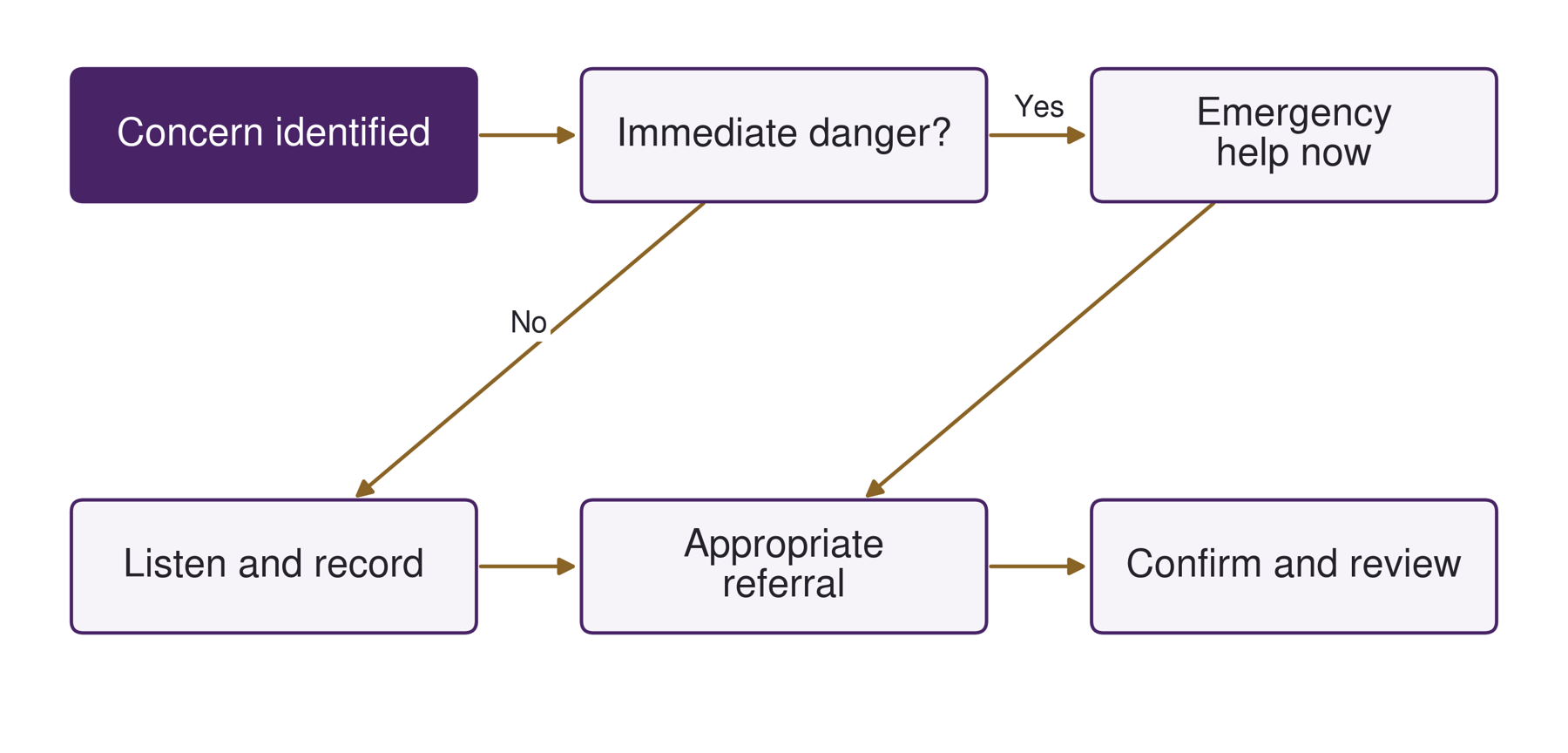
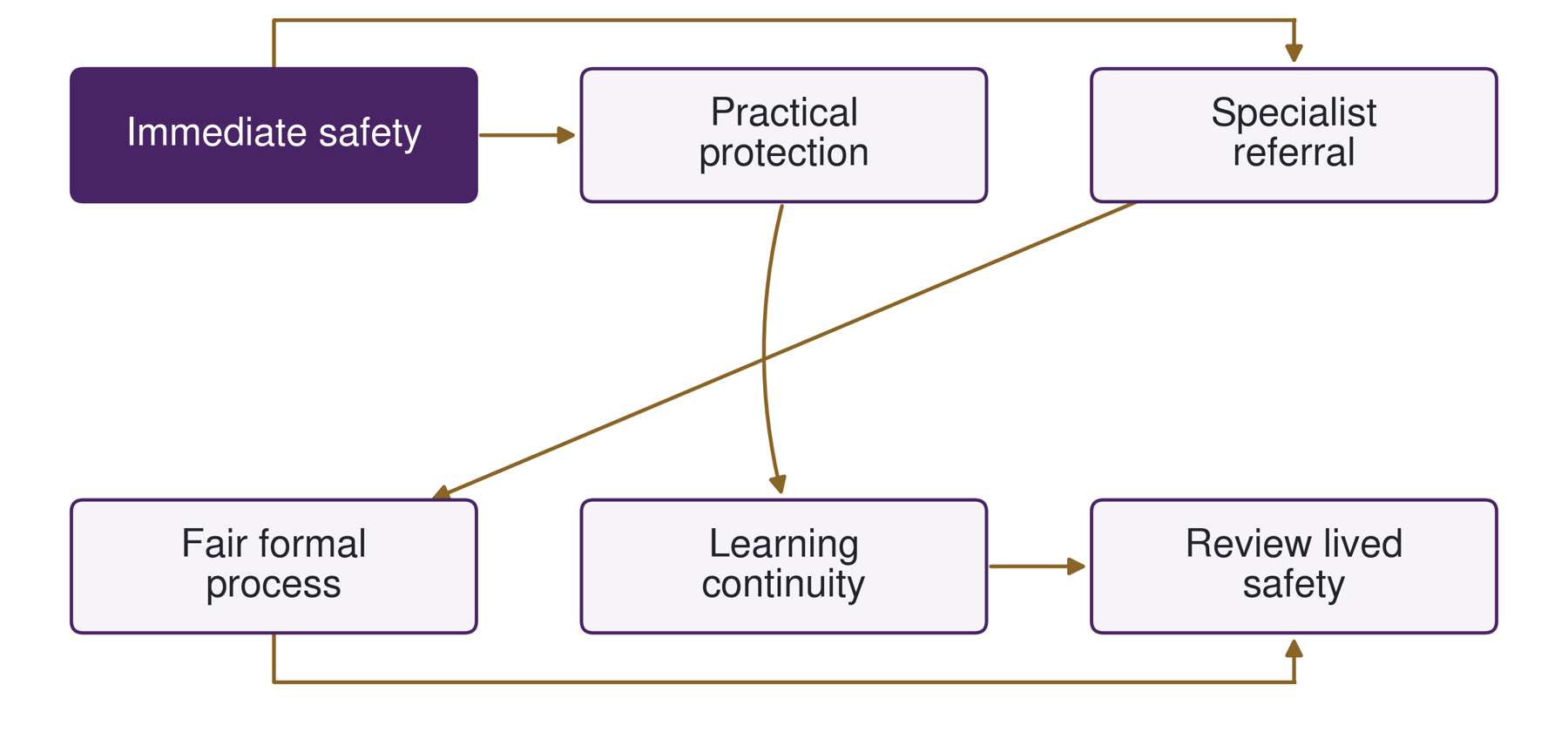
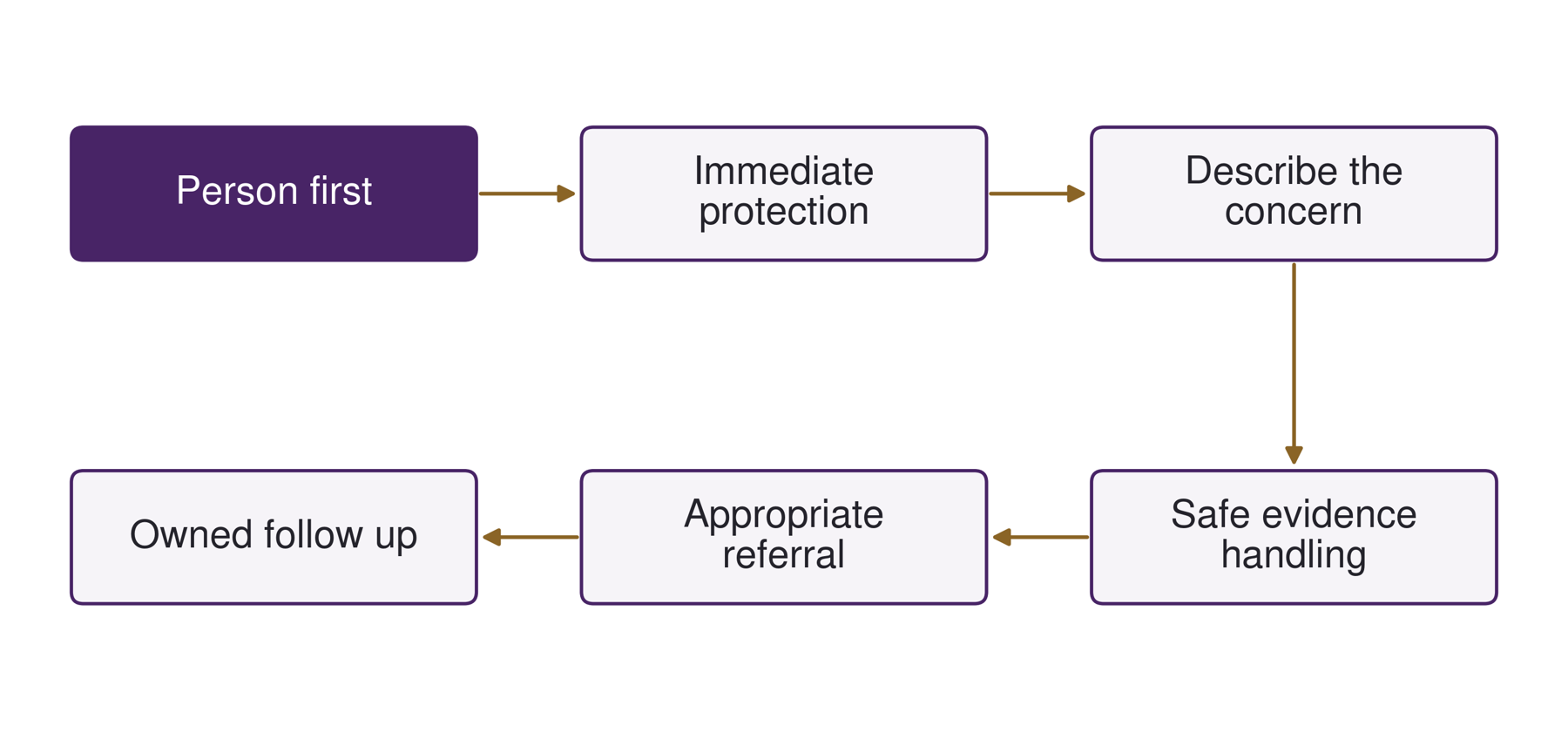
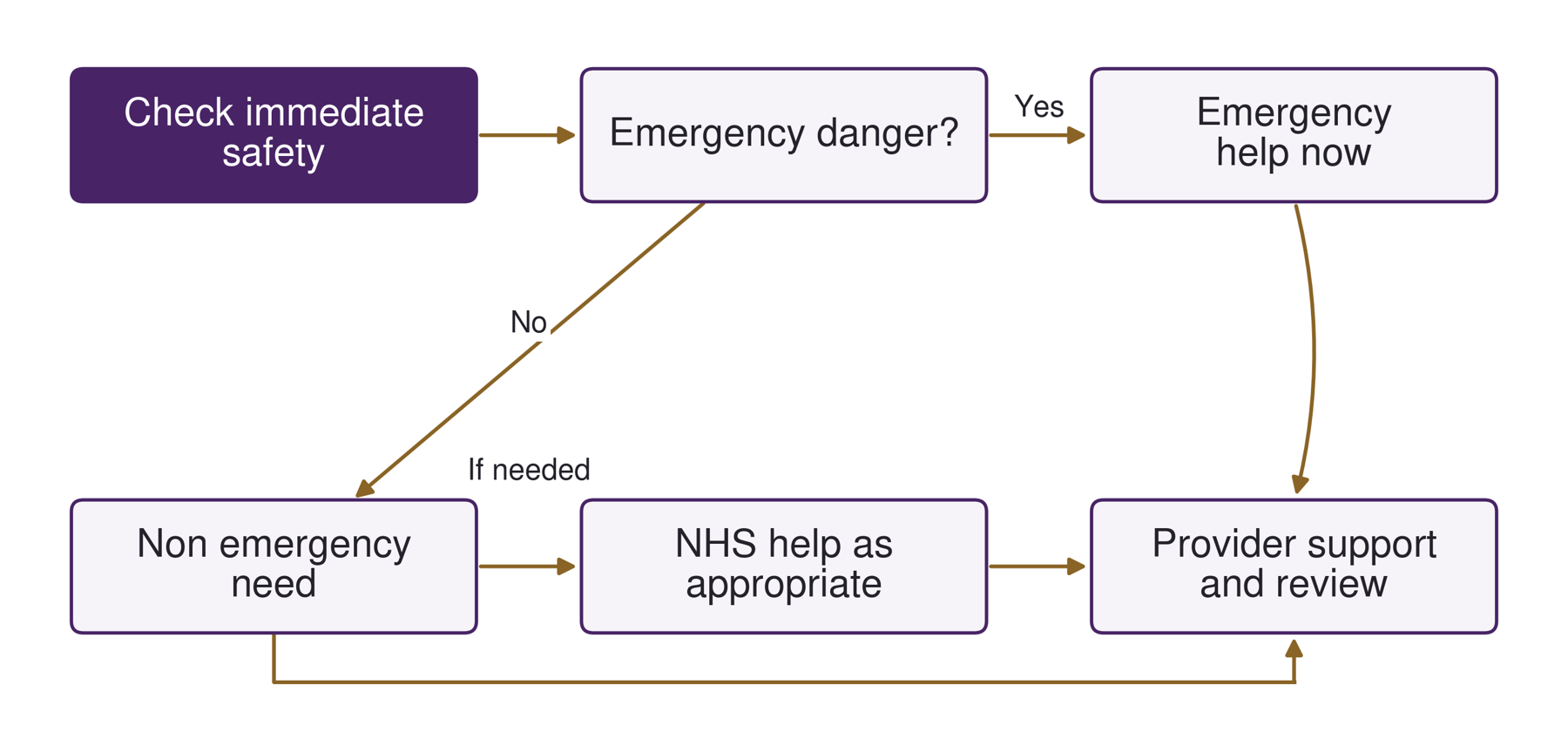
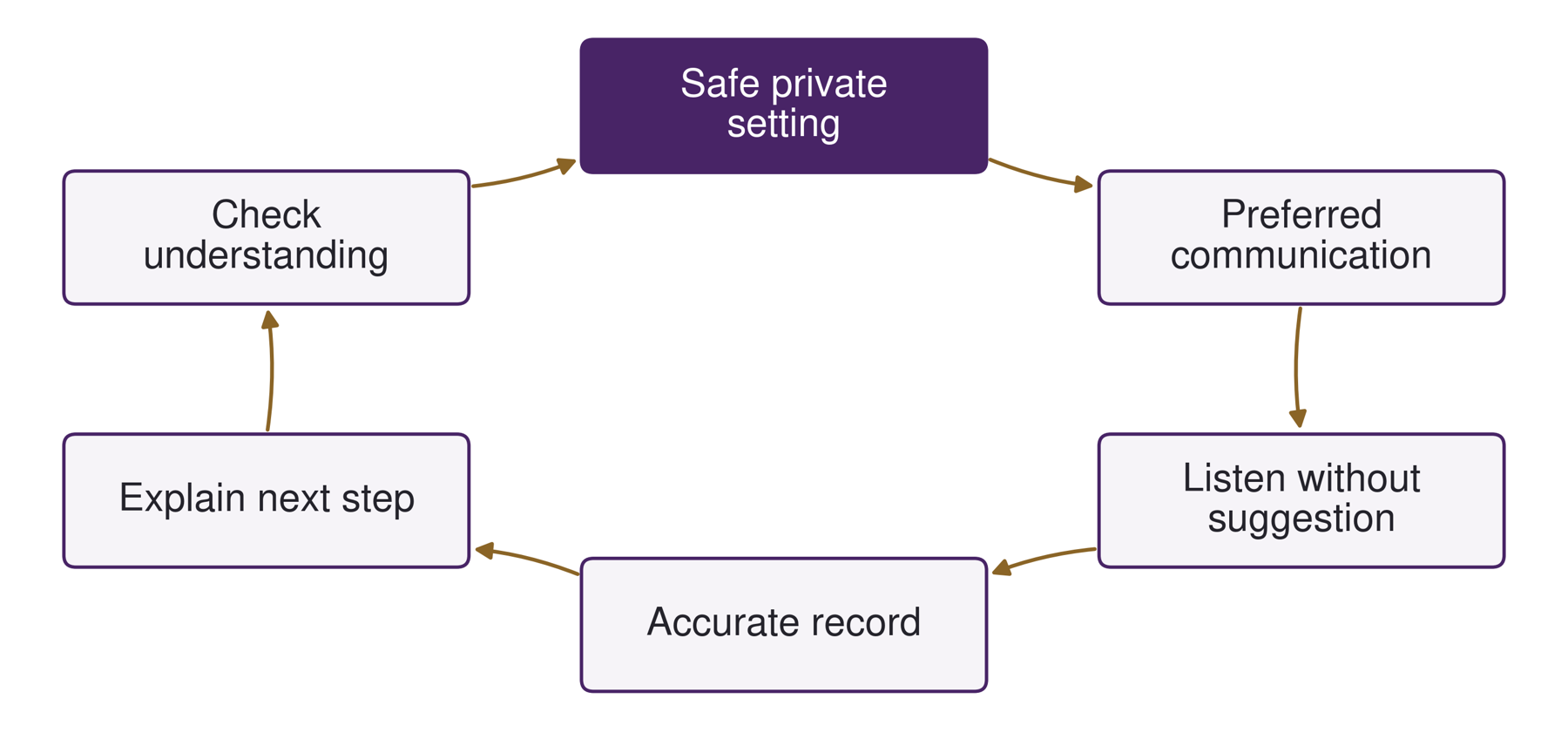
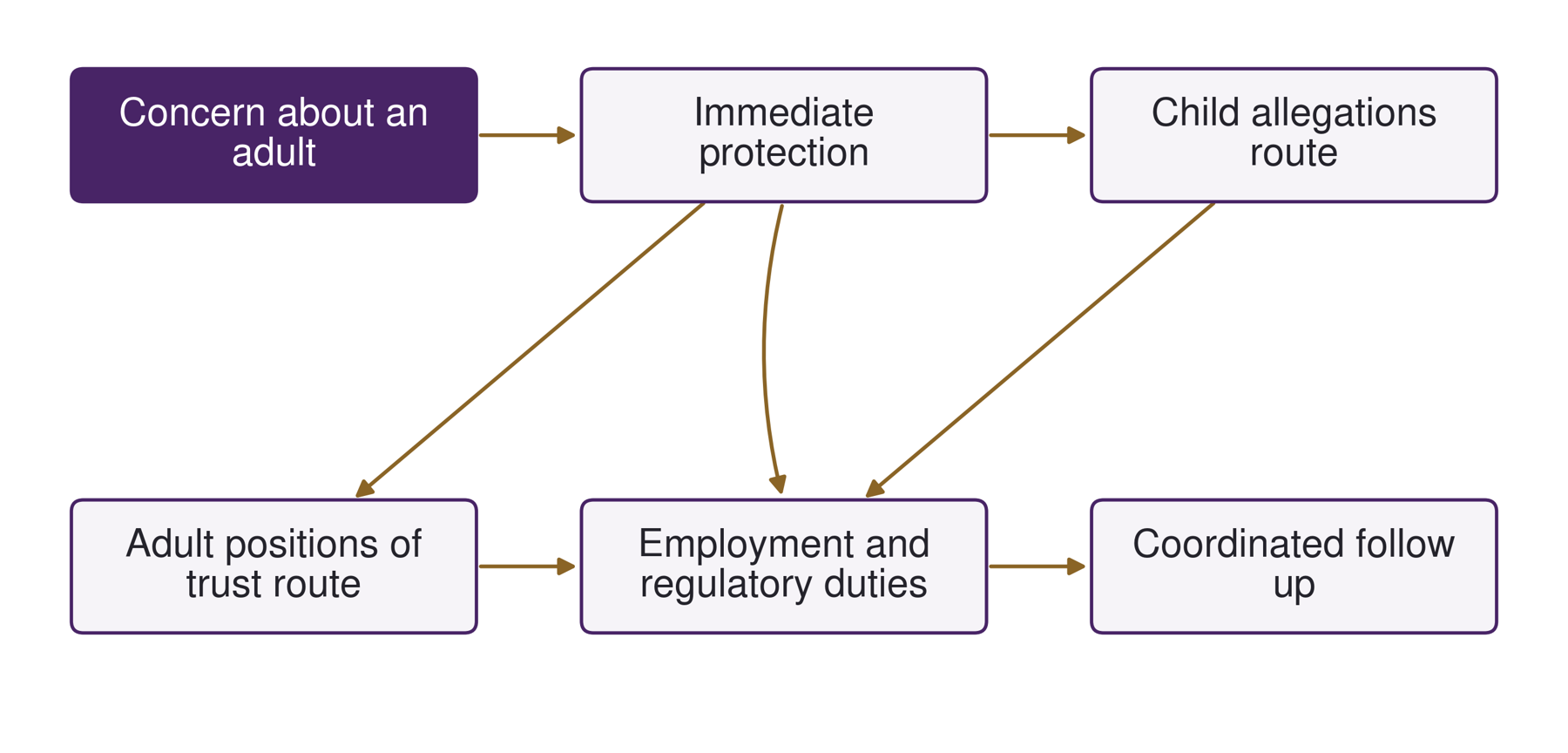
When there is immediate danger, call 999 and take the practical protective action appropriate to the situation. Do not wait to complete a form, contact the usual DSL or gather proof. If the concern is not an emergency, listen calmly, establish what is needed to understand immediate safety, and use the provider's safeguarding route promptly. A practitioner should not confront the alleged perpetrator or conduct their own investigation.
Explain that information may need to be shared with people who can help. Record the circumstances, the learner's actual words where relevant, your observations, actions and reasoning. Separate what you saw, what someone told you and what you infer. In a fictional teaching example, “the learner said the supervisor blocked the door” is an allegation received; “the supervisor unlawfully imprisoned the learner” is a conclusion that the coach is not equipped to establish.
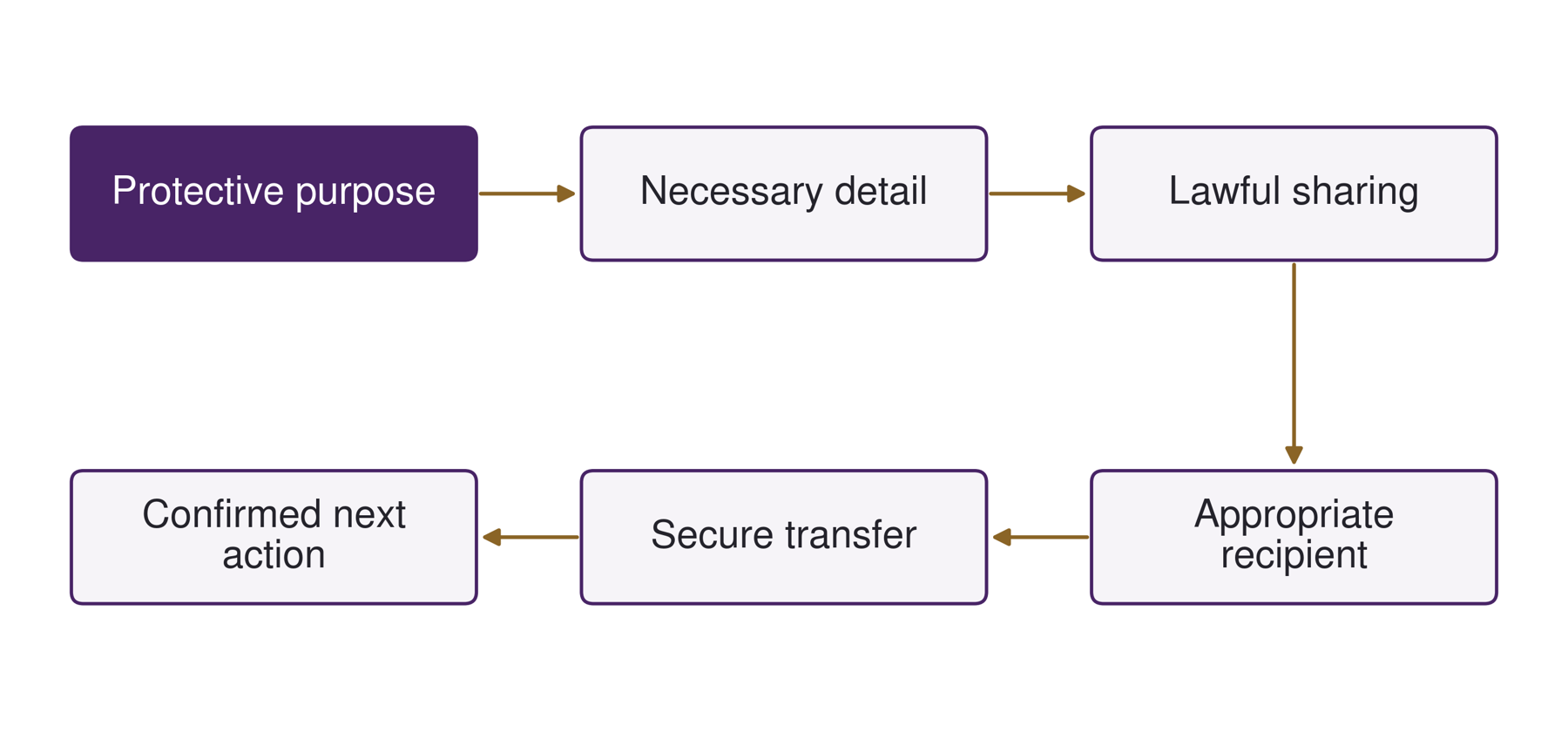
Information should travel with a purpose. Ask who needs which detail to make the next decision. Current ICO guidance includes recognised legitimate interest among seven lawful bases, but it is not a blanket exemption. Additional requirements apply to health information and criminal allegations. The provider's privacy arrangements should make lawful, necessary sharing workable; uncertainty about terminology should not create avoidable delay in protection. [010]
Use a closed-loop handover: send through the approved channel, check receipt, establish the next owner, and record what happens if no response arrives. Preserve appropriate access restrictions. A general progress log might record that the learner has an agreed adjustment and named contact; it should not become a duplicate confidential safeguarding file. Chapter 2 examines response and information handling in detail.
book p. 7 (PDF opens in a new tab)1.10 Case study one the review that cannot be privatebook pp. 7–8
Leila is a fictional 17-year-old business administrator. At three online reviews her workplace supervisor remains behind the camera and answers questions for her. Her written work remains strong, so her coach initially assumes that she appreciates the support. In a short message sent later, Leila asks whether failing probation would end her apprenticeship. She adds that she is frightened to speak honestly while at work, but does not describe a specific incident.
There is uncertainty, but also enough information to change the response. The coach should not diagnose abuse or confront the supervisor. They should establish a safe way and time to communicate with Leila, consider immediate safety and report the concern through the safeguarding route. Because Leila is under 18, her employment and apparent competence do not remove the child safeguarding framework. If further information indicates significant harm or likely significant harm, the response must not wait for the scheduled review.
The coach's next conversation should use open, limited questions rather than suggest a story. “What makes it difficult to speak at work?” is different from “Is your supervisor threatening you?” The safeguarding lead decides the appropriate next route with relevant advice, while the coach preserves access to learning. Contact with parents or the employer requires consideration of whether it could increase danger.
Worked plan A restoring safe communication
This is a provider support plan, not a substitute for referral or an agency protection plan. Timings are illustrative KBC operational standards and must shorten when circumstances require.
| Action | Owner | Time or trigger | Evidence of progress | Escalation |
|---|---|---|---|---|
| Check immediate safety and agree a safe contact channel | Coach with safeguarding lead | On receiving the message | Learner confirms which contact is safe | Emergency services if immediate danger emerges |
| Review the concern and determine referral needs | Safeguarding lead or deputy | Promptly after receipt | Decision, rationale and next owner recorded | External safeguarding advice if uncertainty or delay persists |
| Arrange a private review without exposing the concern unnecessarily | Coach and authorised workplace contact | Before the next planned review | Leila can speak without the supervisor present | Reassess placement arrangements if privacy remains impossible |
| Protect participation while concerns are addressed | Programme manager | Whenever timetable changes | Agreed learning activity remains accessible | Senior leader resolves obstruction |
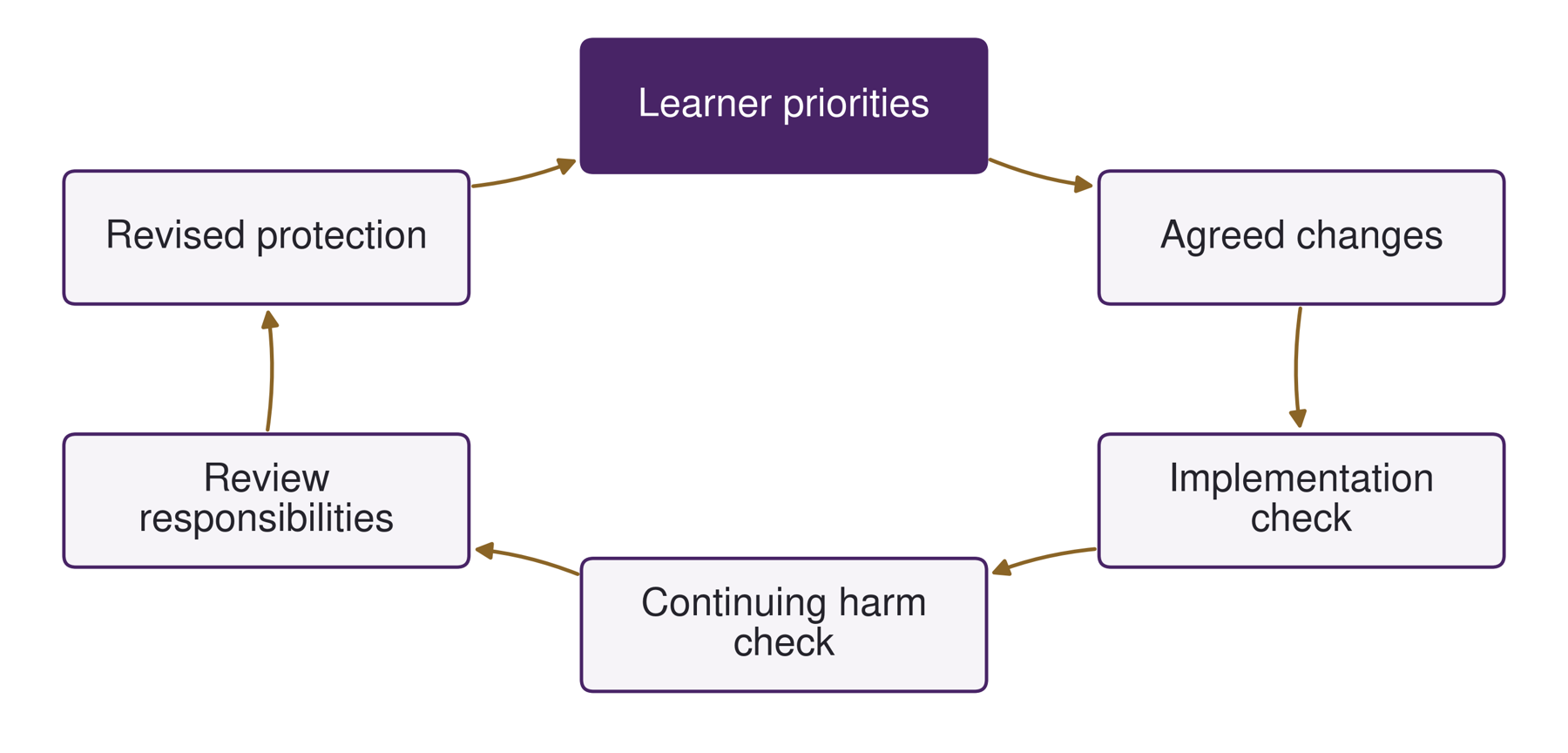
| Review the learner's experience of the arrangements | Named coach | At the agreed check-in and after any change | Leila describes whether communication feels safer | Reopen assessment if fear or retaliation increases |
The plan succeeds when Leila gains a usable route to help and relevant concerns receive an appropriate response, not merely when a meeting is booked.
book pp. 7–8 (PDF opens in a new tab)1.11 Case study two an adult who refuses the proposed helpbook pp. 8–9
Rob is a fictional 29-year-old apprentice working in hospitality. He tells his tutor that he owes money and has allowed an acquaintance to keep his bank card. The acquaintance sometimes waits outside work. Rob asks for extra time on an assignment but does not want the tutor to contact anyone. He explains that he has managed difficult situations before and does not regard himself as vulnerable.
The tutor should take both the information and Rob's wishes seriously. They can ask enough to understand immediate safety, explain the limits of confidentiality and seek safeguarding advice. They should avoid turning the conversation into an interview about possible offences. The bank-card arrangement and waiting outside could have several explanations; neither proves coercion, but both deserve attention in context.
An adult safeguarding referral under the Care Act is not determined simply by Rob's age, debt or refusal. The provider needs to consider whether relevant care and support needs affect his ability to protect himself. The lack of evidence for that threshold does not mean “no safeguarding issue” in the ordinary provider sense. Crime, exploitation, welfare and employment support routes may still matter. [003]
The learning adjustment can proceed alongside appropriate safety action. Withholding an extension until Rob accepts a service would make educational support a bargaining tool. Equally, an extension alone would leave the disclosed situation unexamined. Record what Rob wants, the information available, what is shared and why, and who will make the next contact.
At review, ask whether the agreed contact is still safe and whether circumstances have changed. Do not demand a successful personal outcome as proof of engagement. A capable adult may make decisions staff dislike. Professional disagreement calls for careful reasoning, proportionate action and suitable advice, not automatic substitution of the provider's preferences for the learner's choices.
book pp. 8–9 (PDF opens in a new tab)1.12 Case study three disagreement is not a diagnosisbook pp. 9–10
Sana is a fictional 22-year-old degree apprentice. During a seminar she criticises government foreign policy in forceful terms and argues for lawful protest. Another participant calls her views extremist and asks the tutor to make a Prevent referral. Separately, Sana has missed two sessions and appears tired. No threats, endorsement of terrorism or intimidating conduct have been reported.
The tutor should address the classroom exchange fairly and distinguish its elements. Political disagreement, an accusation by a peer and attendance concerns are not interchangeable evidence. On these facts, the immediate work is to maintain respectful debate, challenge inappropriate labelling and offer a private conversation about participation. The tutor should not assume that Sana's background or the topic of her argument explains her tiredness.
Sana later explains that she has changed shifts and is caring for a relative. A proportionate learning response might clarify release time, offer an accessible route to catch up and agree a review. It should not require her to abandon a lawful opinion. If genuinely new information later indicates a concern connected with terrorism, staff should assess that information through the appropriate route; an earlier welfare explanation should not prevent reconsideration.
This case illustrates how accurate records protect both safety and rights. “Participant expressed support for lawful protest” and “peer described that view as extremist” preserve the distinction between an event and another person's interpretation. Recording simply “extremist views” would create an unsupported label that could influence future decisions.
A supervision discussion can examine why the team initially found the allegation persuasive. Did an unfamiliar viewpoint receive different treatment from an equivalent argument expressed by another learner? What evidence would justify a different response? These questions build professional judgement without turning discussion into a contest over staff members' personal politics.
1.13 Case study four a concern lost between organisationsbook pp. 10–11
Ben is a fictional 20-year-old apprentice whose training is partly subcontracted. He reports repeated intrusive messages from a workplace mentor to a subcontractor tutor. The tutor emails an unmonitored address at the lead provider and assumes the matter is being managed. Ben receives no reply and stops attending reviews. A programme manager later sees only the attendance decline and begins a withdrawal discussion.
Once the communication failure is recognised, the first priority is to establish Ben's current safety and make a proper safeguarding handover. Staff should acknowledge the missed response without speculating about whether the allegation is proven. They should explain the next contact and consider how to protect learning opportunities while relevant concerns are addressed. Ben should not have to repeat unnecessary detail to every organisation.
There are two linked responsibilities: respond to the individual concern and repair the process that lost it. Completing one does not complete the other. A new email address alone will not help if staff continue to assume that sending equals acceptance. The programme manager should also review whether other learners may have been affected by the same reporting failure.
Worked plan B repairing the handover
| Action | Owner | Time or trigger | Evidence of progress | Escalation |
|---|---|---|---|---|
| Re-establish safe contact and assess the current concern | Safeguarding lead and named learner contact | Immediately on discovering the failure | Contact, safety decision and referral actions recorded | Emergency or external safeguarding route when indicated |
| Review educational decisions made without the concern information | Programme manager | Before further withdrawal action | Decisions reconsidered with relevant limited information | Senior leader where harm or unfairness may continue |
| Confirm primary and deputy referral routes with the subcontractor | Contract manager and safeguarding leads | Before further delivery relying on the old route | Named recipients and tested acknowledgement process | Suspend reliance on a route that remains unverified |
| Check for other missed messages through authorised access | Safeguarding lead with privacy and technical support | As part of the incident review | Relevant messages identified and acted upon securely | Escalate any additional unaddressed concern |
| Test the revised process with fictional information | Quality manager | After repair and at a planned review | Receipt and ownership confirmed in a timed exercise | Redesign the process if the test exposes another gap |
The final action is an administrative improvement test, not an experiment with whether a real learner receives urgent protection. PDSA research supports explicit predictions and measurement while also showing why simply naming a cycle is insufficient evidence of effective improvement. [011]
book pp. 10–11 (PDF opens in a new tab)1.14 Evidence of effective provision and inspection expectationsbook p. 11
Under the September 2026 FE and skills toolkit, safeguarding is a whole-provider evaluation graded Met or Not met. Exceptional is a grade in other evaluation areas; it is not a safeguarding grade or an outcome this handbook can guarantee. Inspectors focus on normal practice and its impact, rather than requiring a special presentation format created for inspection. [012]
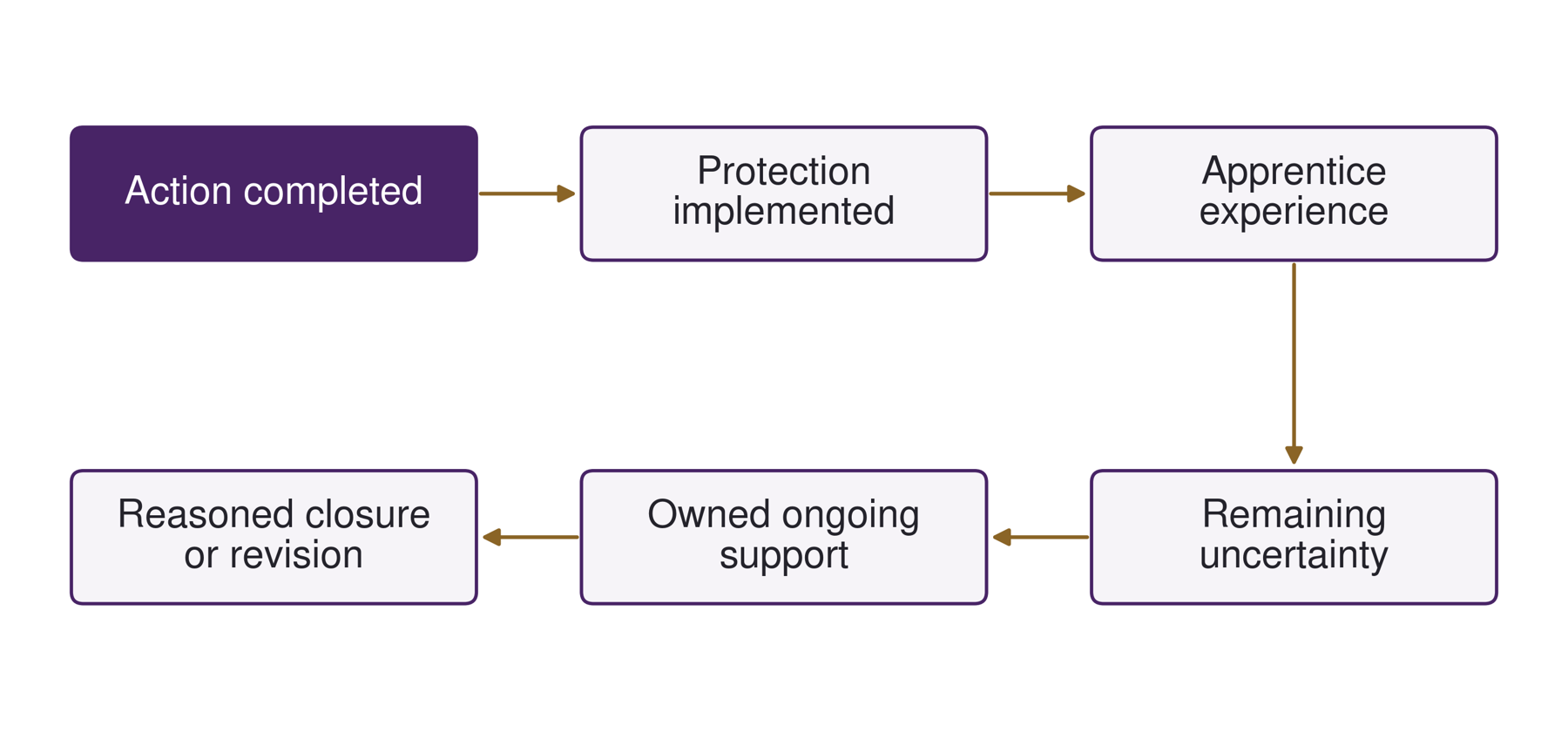
A useful provider evidence trail follows the learner's experience: a concern could be raised; someone understood it; an appropriate decision followed; allocated actions happened; and their effect was reviewed. A completed training register supports this account but does not establish it on its own. Neither does an attractive policy, a signed learner declaration or a large collection of screenshots.
Use several forms of evidence together. Case sampling can reveal delays. Learner discussions can reveal whether reporting feels safe. Employer conversations can show whether staff understand their responsibilities. An accessibility check can expose a reporting form that some learners cannot use. These sources answer different questions, so disagreement between them is informative rather than inconvenient.
Treat numbers carefully. More concerns may reflect improved trust, greater harm, better recording or several changes together. Fewer concerns may reflect silence. The national Review Panel has warned that a reduction in serious incident notifications may indicate under-reporting. Its selected review cases cannot be used as a prevalence estimate for apprentices. [013]
Leaders should therefore ask what changed, for whom, and how they know. A claim of effective practice becomes stronger when the provider can show how it recognised a weakness, acted on it and checked whether the apprentice's experience improved.
book p. 11 (PDF opens in a new tab)1.15 How to use the handbook and turn learning into practicebook pp. 11–12
Read Chapter 2 for recognition, first response and information sharing. Chapters 3 to 5 address abuse, sexual harm and exploitation. Chapters 6 and 7 examine digital environments and mental-health-related safeguarding. Chapter 8 considers disability and adults with care and support needs. Chapters 9 and 10 develop Prevent judgement, referrals and partnership work. Chapter 11 addresses leadership, recruitment and organisational culture. Chapter 12 explains the design, management, review and closure of action plans.
The cases are fictional and the frameworks are KBC learning aids. Adapt their reasoning to the facts, setting and current procedures; do not copy their actions mechanically. Each chapter's forty questions test application and discrimination between plausible responses. A high score is useful feedback about learning, not accreditation or proof that someone can safely manage every real concern without supervision.
Use supervision to make uncertainty discussable. Select one case and ask what was known at the time, what was inferred, whose perspective was absent and what would have changed the decision. Avoid judging an earlier decision only through facts discovered later. Identify one practical improvement and give it an owner, trigger and review point. Research on implementation intentions supports specifying when and how an action will occur; applying it to safeguarding planning is an inference, not evidence that a formula removes uncertainty. [014]
Practice review
Trace how an apprentice could raise a concern when the usual coach is absent. Explain the route without using unexplained abbreviations. Then test whether a learner can use it privately and whether the receiving person would acknowledge ownership. Finally, identify which parts of the process require improvement now and who has authority to make those changes.
Evidence notes
Official guidance defines duties within its scope; it cannot resolve every factual scenario. Serious case reviews and academic systems and planning research inform judgement, but the cited studies do not evaluate this handbook or its apprenticeship models. Combine current duties, local knowledge, learner experience and specialist advice to improve safety, while making uncertainty explicit.
book pp. 11–12 (PDF opens in a new tab)