
Complexity is manageable when decisions, evidence and accountability are connected.
Professionals need to translate engineering, commercial, schedule, risk and stakeholder data into one trusted view of delivery.
Professional development for project, PMO and project controls professionals working across regulated utilities, major capital investment, oil and gas, and the energy transition.
Energy organisations must balance operational resilience, affordability, regulation, capital discipline and decarbonisation. Strong controls make those trade-offs visible and manageable.
Professionals need to translate engineering, commercial, schedule, risk and stakeholder data into one trusted view of delivery.
Protect safety, service continuity, compliance and asset performance while change is delivered.
Create credible baselines, forecast outcomes and govern cost and change transparently.
Connect sustainability, technology options, policy and long-term value to programme decisions.
Turn technical information into implications, options, recommendations and clear action.
Select a sector to explore the priorities, risks and expected outputs.
Develop the governance and controls required for regulated networks, generation, water, transmission, distribution and large asset portfolios. The focus is resilience, investment confidence, regulatory evidence and consistent delivery standards.
Pathways can support individual career development or employer cohorts focused on common standards and live portfolio challenges.
Move from administrative reporting to proportionate governance, challenge, assurance and decision support.
Develop integrated schedules, logic, milestones, critical path insight and recovery options.
Connect estimates, budgets, contracts, progress, EVM and forecasting into one credible view.
Integrate uncertainty, configuration, assurance and sustainability into delivery decisions and controls.
The focus is practical transfer: professional artefacts, clear judgement and measurable improvement rather than theory alone.
Decision rights, RACI, escalation routes, assurance cadence and management forums.
Scope, schedule, cost, resources, risk and change connected into one credible management view.
Structured registers, scenarios, exposure, ownership, escalation and quantitative insight.
Clear narrative, options, implications and recommended actions for senior stakeholders.
Impact assessment, approval workflow, version integrity and auditable decision records.
Authentic artefacts and reflective evidence to support progression and professional recognition.
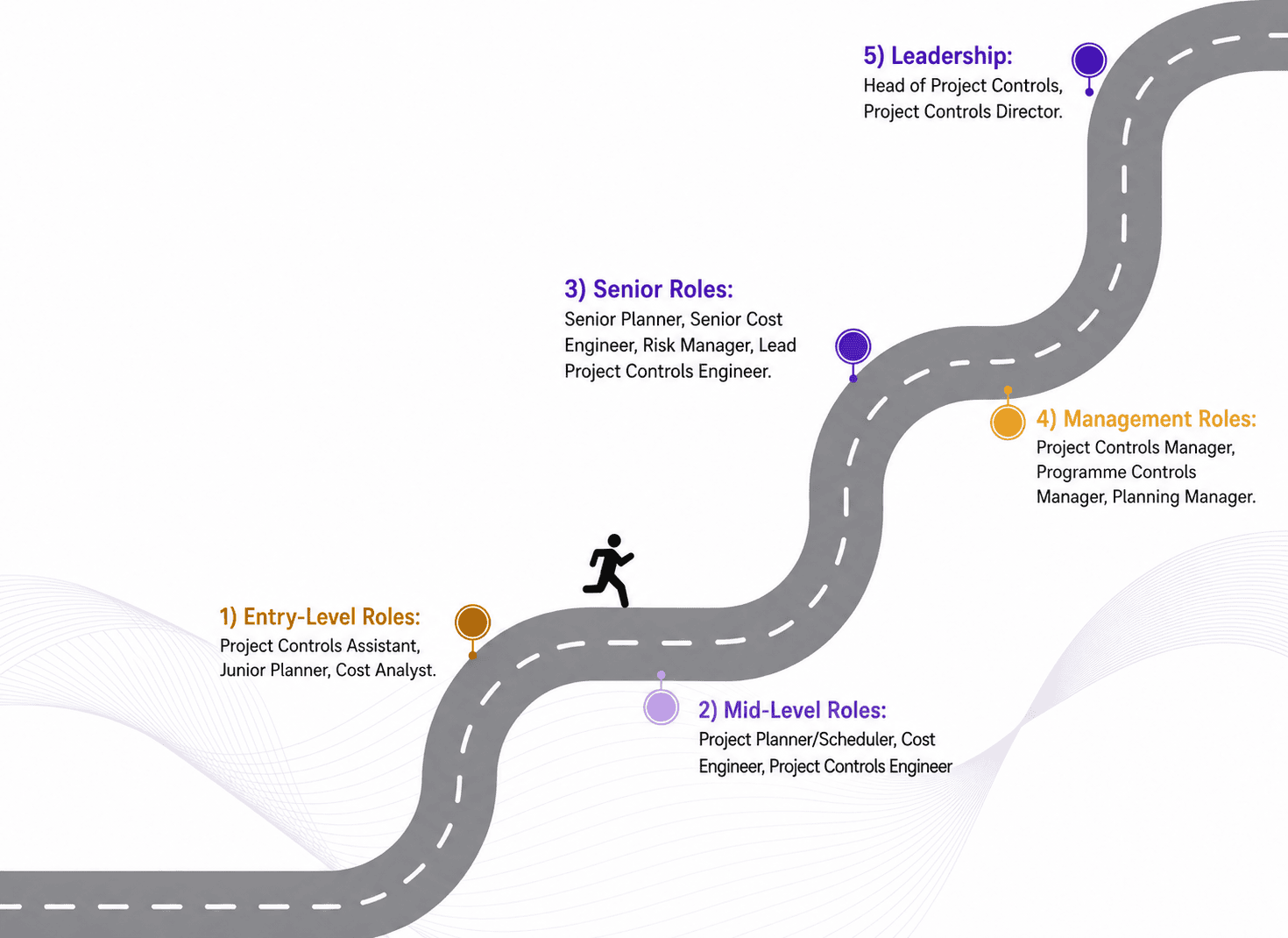
The pathways support progression across PMO, controls, assurance, programme leadership and energy-transition portfolios.
Set governance standards, challenge delivery confidence and influence investment and intervention decisions.
Integrate planning, cost, risk, change and reporting across major programmes and supplier ecosystems.
Connect technology, policy, benefits, sustainability and stakeholder priorities to executable portfolios.
Build proactive uncertainty, quality, review and learning systems that improve delivery confidence.
Create and challenge integrated schedules, critical paths, interfaces, forecasts and recovery strategies.
Convert complex performance data into decision-ready narrative, trend insight and executive action.
A repeatable learning cycle connects live teaching to workplace outcomes and professional reflection.
Connect structured teaching, peer discussion and tutor feedback to the decisions, evidence and outcomes required in your workplace.
Review focused reading, diagnostic questions or a live workplace challenge.
Work through concepts, sector cases, decisions, tools and practical examples with a tutor.
Use the framework, template or technique in an authentic or approved simulated context.
Evaluate effectiveness, capture evidence and define the next improvement action.
Employer cohorts can align learning to shared standards, priority portfolios and targeted capability gaps while retaining independent assessment and professional judgement.
Structure delivery around sector challenges, organisational standards, live portfolio priorities and role-specific expectations.
Managers can support access to suitable projects, provide contextual feedback and help embed improved practices without compromising assessment independence.
Explore technical judgement, controls leadership, regulated delivery, sustainability, cost, risk and examples of measurable workplace impact.
They are designed for project, programme, PMO, planning, cost, risk, assurance and project-controls professionals working in or moving into energy, utilities, oil and gas, infrastructure or net-zero environments.
No. Engineering experience can be valuable, but the core focus is professional capability in project controls, governance, assurance, reporting and decision support. Programme fit is confirmed through the Kent Business College admissions process.
Yes, where organisational permission and confidentiality controls are in place. Approved simulated scenarios can be used where access to live information is restricted.
Employer delivery can be structured around shared sector challenges, roles, standards and portfolio priorities, subject to an agreed scope and delivery plan.
Discuss your sector, role, development objectives and the most suitable learning pathway with Kent Business College.
An Unparalleled Journey into Refined Connection
This is not merely an event; it is an introduction to an elevated way of life. The Nottingham Club officially opens its doors in Week 29, marking the dawn of a new era for our city’s distinguished and ambitious.
Join us in an intimate celebration, set within a truly unique, wood-paneled space that speaks to….