
Employer Guide to Apprenticeship Progress Reviews
Everything you need to know about supporting your apprentice through their learning journey and progress review process.
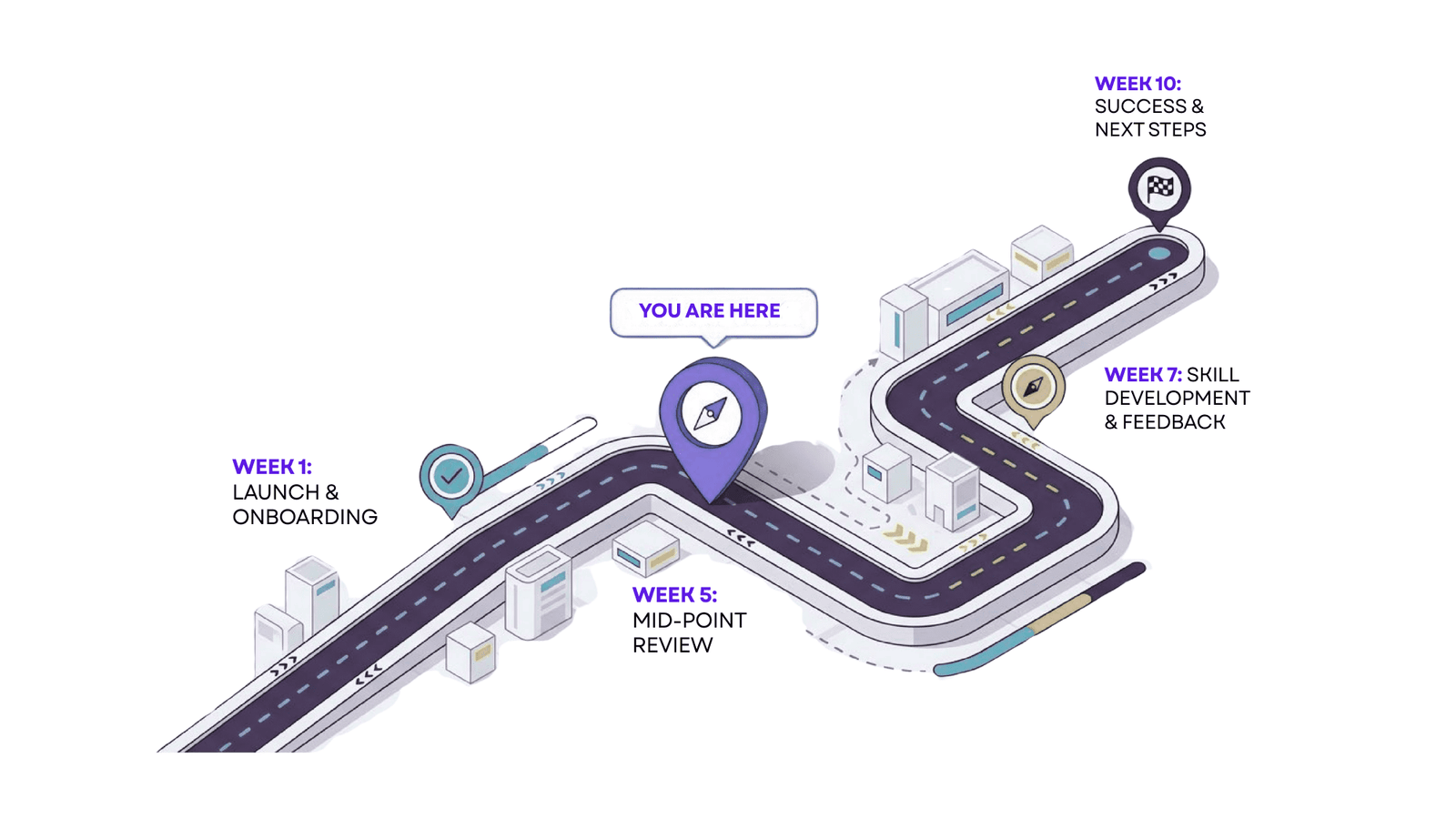
Your Roadmap to Success
“The KBC Student Progress Review
A 10-Week Navigation Check for Apprentices and Line Managers.”
Check the Map
Review progress against the training plan.
Refuel
Identify support needs and wellbeing.
Adjust Route.
Set new targets to reach the End-Point Assessment.
Section 1
Introduction
Kent Business College (KBC) delivers apprenticeship programmes that combine structured training with real workplace experience. A key part of this delivery is the Student Progress Review.
A Progress Review is a structured, formal meeting involving:
- The apprentice
- The employer (usually the line manager)
- The assigned KBC coach
This policy explains:
- What a Progress Review is
- Why it is important
- What will be discussed
- The responsibilities of each party
- The Service Level Agreement (SLA)
This document is written to ensure clarity for employers, apprentices and members of the public who may be unfamiliar with apprenticeship frameworks.

Section 2
What is an Apprenticeship?
An apprenticeship is a paid job combined with structured training.
It includes:
- On-the-job learning (workplace activity)
- Off-the-Job (OTJ) training (structured learning outside normal job duties)
- Development of Knowledge, Skills and Behaviours (KSBs)
- End-Point Assessment (EPA) to confirm competence
Apprenticeships are funded through public funds and are regulated by the Department for Education. Providers must demonstrate that learning is structured, monitored, and progressing appropriately.
Progress Reviews are a mandatory part of this monitoring process.

The Student Progress Review exists to ensure that:
- The apprentice is making meaningful progress.
- The employer is seeing value from the apprenticeship.
- The training plan remains aligned to the job role.
- Off-the-Job training requirements are met.
- The apprentice is progressing towards End-Point Assessment
Progress Reviews protect:
- The apprentice’s development
- The employer’s investment
- Public funding accountability
- Quality standards required by regulators
Section 3
Purpose of the
Student Progress Review
Section 4
Regulatory Alignment
- The Department for Education (Apprenticeship Funding Rules)
- The Education and Skills Funding Agency (Funding compliance monitoring)
- Ofsted (Education Inspection Framework)
These bodies require that apprenticeships are:
- Regularly reviewed
- Developmentally structured
- Employer engaged
- Evidenced against clear standards
Failure to comply may result in funding clawback or regulatory action.

Section 5
Importance and Justification
Progress Reviews are important because they:
5.1
- Understand their development
- Receive appropriate support
- Are not falling behind
- Are supported in achieving their qualification
5.2
Protect Employers
- Structured feedback on apprentice performance
- Visibility of return on investment
- Clear next steps
- Early identification of issues
5.3
- Structured monitoring
- Genuine training
- Meaningful progress
5.4
Support Inspection Standards
- Quality of Education
- Personal Development
- Leadership and Management
Section 6
Frequency and Service Level Agreement (SLA)
Kent Business College operates the following standards:
| Requirement | KBC Standard |
|---|---|
| Review Frequency | Every 10 weeks |
| Regulatory Maximum Interval | No more than 12 weeks |
| Duration | 45–60 minutes |
| Format | Tripartite meeting (Apprentice, Employer, Provider) |
| Documentation Completion | Within 48 hours |
| Signatures Required | All three parties |
Section 7
Structure of the Progress Review
Each Progress Review includes:
- Confirmation the apprentice remains employed
- Confirmation the role aligns to the apprenticeship standard
- dentification of any role changes
7.2
- Hours completed to date
- Evidence of structured learning
- Application of learning to workplace
7.3
- Live session attendance
- Submission of work
- Engagement with learning platform
7.4
- Were targets achieved?
- What evidence supports achievement?
- What was the workplace impact?
7.5
- What knowledge has been developed?
- What skills have been applied?
- What behaviours have been demonstrated?
7.6
- Performance observations
- Development commentary
- Areas for improvement
7.7
- Wellbeing check
- Workload review
- Additional support required
7.8
Forward Action Plan
Clear SMART targets will be agreed for the next review period.
Section 8
Responsibilities
Each Progress Review includes:
8.1
Coach Responsibilities
- Prepare thoroughly
- Review progress data
- Facilitate professional discussion
- Challenge and support appropriately
- Document accurately
- Identify risks early
- Escalate concerns where necessary
8.2
The employer must:
- Attend Progress Reviews
- Provide honest performance feedback
- Support Off-the-Job training time
- Facilitate workplace application of learning
- Notify KBC of role changes
8.3
Apprentice Responsibilities
The apprentice must:
- Attend all scheduled reviews
- Engage honestly in reflection
- Complete agreed learning tasks
- Log Off-the-Job hours accurately
- Inform KBC of any changes affecting progress
Section 9
Non-Attendance and Escalation Procedure
Each Progress Review includes:

If the Apprentice Fails to Attend
Stage 1 –
Contact within 48 hours
Stage 2 –
Formal reminder and reschedule
Stage 3 –
Employer notified
Stage 4 –
Escalation to Programme Lead
Stage 5 –
Formal review of apprenticeship continuation

If the Employer Fails to Attend
Stage 1 –
Review rescheduled
Stage 2 –
Formal email to employer
Stage 3 –
Escalation to Employer Engagement Officer
Stage 4 –
Senior Leadership notification
Section 10
Risk Management
Risks identified during reviews may include:
- Off-the-Job hours deficit
- Poor attendance
- Insufficient portfolio progress
- Employer disengagement
- Risk of EPA failure
Action plans must be agreed and documented immediately.
Section 11
Documentation and Audit
All reviews:
- Must be recorded using the official KBC template
- Must be stored securely
- Must be retrievable for inspection
- Must demonstrate impact and progress
Section 12
Data Protection and Confidentiality
All information discussed in Progress Reviews:
- Is confidential
- Is handled in line with GDPR requirements
- May be shared with regulatory bodies if required
Section 13
Quality Assurance
Kent Business College conducts:
- Monthly review sampling
- Coach performance monitoring
- Continuous improvement feedback
- Compliance audits
Policy Review
This policy will be reviewed annually or sooner if regulatory requirements change.
Section 1
Introduction
Thank you for employing an apprentice with Kent Business College (KBC).
- The employer
- The apprentice
- The training provider
A key part of this partnership is the Progress Review.
This guide explains:
- What a Progress Review is
- Why it is important
- What you can expect
- Your responsibilities as an employer
- How it benefits your organisation

Section 2
What is a Progress Review?
A Progress Review is a structured meeting that takes place approximately every 10 weeks.
It involves:
- The apprentice
- The employer (usually the line manager)
- The KBC coach
- The apprentice’s development
- Workplace performance
- Off-the-Job training progress
- Progress towards End-Point Assessment
Progress Reviews are a mandatory requirement of
apprenticeship funding regulations.

Section 3
Why Are Progress Reviews Important?
3.1
- You are receiving value from the apprenticeship
- The apprentice is developing skills relevant to your business
- Training aligns with real workplace objectives
- Performance gaps are addressed early
3.2
- Structured feedback
- Clear development goals
- Support and guidance
- A clear pathway to qualification
3.3

Section 4
What Happens During a Progress Review?
Each review typically lasts 45–60 minutes and covers:
4.1
- The apprentice remains employed
- The role continues to align with the apprenticeship standard
- Any changes to responsibilities are discussed
4.2
- Hours completed
- Types of learning undertaken
- Application of learning to workplace tasks
4.3
Review of Previous Targets
- What was agreed at the last review
- What has been achieved
- Evidence of progress
- Impact on business performance
4.4
Every apprenticeship standard includes:
- Knowledge (what the apprentice understands)
- Skills (what they can do)
- Behaviours (professional standards and conduct)
We review how these are developing in the workplace.
4.5
- Has performance improved?
- What strengths are emerging?
- Where does further development remain?
- Is the apprentice adding value?
4.6
We will check:
- Workload balance
- Wellbeing
- Any support needed
4.7
- SMART targets
- Workplace application activities
- ff-the-Job learning plans
- Preparation steps for End-Point Assessment
Section 5
Your Responsibilities as an Employer
Under apprenticeship funding rules, employers must:
- Support application of learning
- Inform KBC of role changes
- Maintain open communication
- ttend Progress Reviews
- Provide honest performance feedback
- Allow time for Off-the-Job training
Employer engagement is not optional. It is a core part of apprenticeship delivery.

Section 6
What If You Cannot Attend?
Progress Reviews require employer participation. If you cannot attend:
- Notify the coach in advance
- Nominate an appropriate representative
- Arrange a rescheduled date promptly
Section 7
What Are the Benefits
to Your Business?
- Strengthen retention
- Provide structured workforce development
- Demonstrate commitment to staff investment
- Improve employee performance
- Increase productivity
- Develop leadership capability

Section 8
Preparing for a Progress Review
Before the meeting, you may wish to consider:
- What improvements have you observed?
- What responsibilities could be expanded?
- What business challenges could the apprentice support?
- What behaviours need strengthening?
Frequently Asked Questions
Is this just paperwork?
No. It is more of a structured development conversation that protects funding and drives performance.
How long does it take?
Approximately 45–60 minutes every 10 weeks.
Is employer attendance mandatory?
Yes. Apprenticeships are employer-led programmes. Your engagement is required.
What if performance is not satisfactory?
The review allows early identification and support planning before issues escalate.
Final Note
Apprenticeships succeed when there is strong collaboration between employer, apprentice and training provider.
Progress Reviews are NOT a formality. They are
the engine room of apprenticeship success.
We appreciate your partnership in delivering high-quality professional development.
Our Commitment
- Transparent communication
- Professional review processes
- Clear documentation
- Supporting both employer and apprentice success
- Meeting all regulatory requirements
Find Us At :
Safeguarding Lead:
If you have any questions regarding
Progress Reviews, please contact:
Employer Engagement Team
Section 1
Introduction
Welcome to your apprenticeship with
Kent Business College
An apprenticeship is more than a qualification, it is:
- A job
- Structured training
- Professional development
- Preparation for End-Point Assessment (EPA)
A key part of your apprenticeship journey is the Progress Review.
- What a Progress Review is
- Why it matters
- What will be discussed
- What is expected from you
- How it supports your success

Section 2
What Is a Progress Review?
A Progress Review is a formal meeting that takes place approximately every 10 weeks. It involves:
- You (the apprentice)
- Your employer or line manager
- Your Kent Business College coach
It is a structured conversation about:
- Your development
- Your performance at work
- Your learning progress
Progress Reviews are required under government apprenticeship regulations and are a mandatory part of your programme.

Section 3
Why Are Progress Reviews Important?
Progress Reviews help you:
3.1
Stay on Track
- Completing your Off-the-Job training hours
- Developing the required Knowledge, Skills and Behaviours (KSBs)
- Making progress towards EPA
3.2
- Clear feedback
- Recognition of achievements
- Identified areas for improvement
- Structured development targets
3.3
If you are falling behind, struggling with workload, or unsure about expectations, the Progress Review is the place to raise this early. Early discussion prevents bigger issues later.
3.4
Your apprenticeship ends with an End-Point Assessment. Progress Reviews monitor your readiness so that you approach this stage confidently
Section 4
What Will Be Discussed?
Each review usually lasts 45–60 minutes and covers:
4.1
Your Employment
- You are still employed
- Your job role still aligns with your apprenticeship standard
- Any changes to responsibilities
4.2
- How many hours you have completed
- What learning activities you have undertaken
- How you applied your learning at work
4.3
We will discuss:
- What targets were agreed last time
- Whether they were achieved
- What impact they had in your workplace
4.4
Knowledge, Skills and Behaviours (KSBs)
Every apprenticeship includes:
- Knowledge – what you understand
- Skills – what you can do
- Behaviours – how you conduct yourself professionally
We will explore how you are developing in all three areas.
4.5
Employer Feedback
Your line manager will share feedback about:
- Your performance
- Improvements observed
- Areas for development
- Workplace impact
4.6
We will check:
- Your workload balance
- Any wellbeing concerns
- Any additional support needed
4.7
Before the meeting ends, we will agree:
- Clear SMART targets
- Learning priorities
- Workplace application tasks
- Off-the-Job learning focus
These targets guide your next 10 weeks.
Section 5
Your Responsibilities
as an Apprentice
You are expected to:
- Attend all scheduled Progress Reviews
- Engage honestly and professionally
- Log Off-the-Job hours accurately
- Complete agreed assignments
- Apply learning in your workplace
- Inform your coach of any issues affecting your progress
Failure to attend reviews or engage may result in escalation procedures and could affect continuation on the programme.

Section 6
How to Prepare for
Your Progress Review
- Attend all scheduled Progress Reviews
- How have I applied this in my job?
- What am I proud of?
- What am I finding challenging?
- What support do I need?
- Am I on track with Off-the-Job hours?
Section 7
Frequently Asked Questions
Is this just paperwork?
Will I get criticised?
Can I raise concerns about work?
Does this affect my qualification?
Section 8
How Progress Reviews Support Your Career
- Build professional confidence
- Improve performance
- Strengthen communication skills
- Demonstrate leadership behaviours
- Achieve higher EPA grades
- Enhance career progression
Final Message
Your apprenticeship is a partnership. The Progress Review is your opportunity to:
- Reflect
- Improve
- Be challenged
- Be supported
- Stay on track
Take it seriously, prepare for it, and use it to your advantage.
Kent Business College is committed to supporting you throughout your journey.